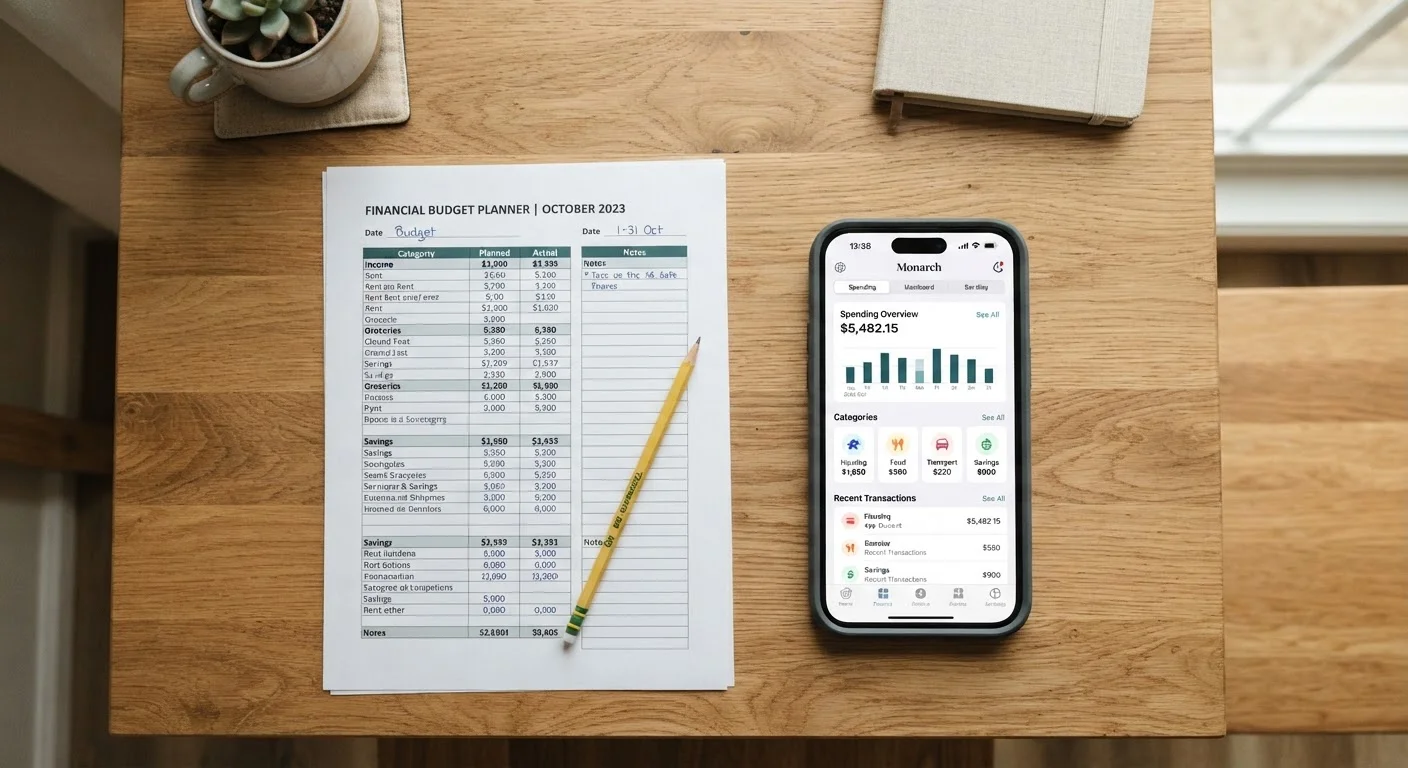

Why a Budget Framework Matters
Most people have a general sense of what they earn and a vague awareness of what they spend. A budget closes that gap with precision. According to NFCC (National Foundation for Credit Counseling) surveys, a significant share of Americans report that they spend without a defined plan — and many carry month-to-month stress about money as a result.
A personal budgeting framework is not a restriction. It is a decision made in advance about where your money goes, so circumstances — an unexpected bill, an impulse purchase, a rough month — don't make that decision for you. Done well, a budget is the single most powerful tool an individual has for moving from financial reaction to financial intention.
This guide walks through the complete process: from accurately measuring income to setting goals you can actually fund. For readers also managing debt or building an emergency cushion, those priorities connect directly to the same framework — see our Credit & Debt hub and Saving & Emergency Funds hub for deeper coverage.
Step 1: Know Your Real Income
Every budget must be grounded in net income — the amount deposited into your account after taxes, benefits deductions, and any other withholdings. Using gross (pre-tax) income is one of the most common first-step errors, and it inflates your budget by anywhere from 20% to 35% before you've spent a cent.
List all reliable income sources:
- Primary employment: regular paycheck (net)
- Side income: freelance, gig work, rental income — use a conservative three-month average, not a peak month
- Regular transfers: child support, alimony, government benefits
If your income varies month to month, budget from your lowest typical month. Any surplus in higher-earning months becomes a bonus that can accelerate savings goals rather than underwrite inflated spending habits.
When calculating variable side income, use your lowest three-month average rather than your best month — this prevents you from budgeting money you may not reliably have.
Budgets built on optimistic income projections frequently collapse in average or below-average months, creating a cycle of shortfalls and discouragement.
Schedule your savings transfer for the same day your paycheck hits — before you log into your checking account for anything else.
Behavioral finance research consistently shows that automating savings before discretionary access dramatically increases the likelihood that savings goals are met.
Step 2: Map Your Expenses
Pull three months of bank and credit card statements and sort every transaction into three categories:
- Fixed expenses
- Costs that are the same every month: rent or mortgage, car payment, insurance premiums, subscription services. These are non-negotiable in the short term.
- Variable necessities
- Costs that fluctuate but are essential: groceries, utilities, gas, prescription medications. These can be managed but not eliminated.
- Discretionary spending
- Everything that reflects choice: dining out, entertainment, clothing beyond basics, hobbies. This is where the most immediate budget flexibility lives.
Most people are surprised by how much discretionary spending accumulates. A $6 coffee three times a week is $936 a year — a number that may or may not align with your priorities once you see it clearly. The goal here is not judgment; it is visibility.
Step 3: Choose a Budgeting Method
No single method works for everyone. The right choice depends on your personality, the complexity of your finances, and how much time you're willing to invest. Three frameworks cover most situations:
The 50/30/20 Rule
Allocate 50% of net income to needs, 30% to wants, and 20% to savings and debt repayment. This is a widely recognized starting point — straightforward enough for beginners, flexible enough to adapt. If your housing costs alone exceed 30% of net income (common in high-cost cities), you may need to compress the wants category rather than the savings category.
Zero-Based Budgeting
Every dollar of income is assigned a job until the balance reaches zero. Income minus all allocations (expenses + savings + debt payments) equals zero. This method demands more attention but leaves no money unaccounted for.
Envelope Budgeting
Set cash or digital spending caps per category for the month. When a category's envelope is empty, spending stops. Particularly effective for controlling discretionary categories where willpower alone tends to fail.
For a detailed look at how to track whichever method you choose, see our guide on manual vs. automated budget tracking.
Step 4: Set Savings Goals That Stick
Vague intentions to "save more" rarely produce results. Effective savings goals share three traits: they are specific (a defined dollar amount), time-bound (a target date), and funded first — meaning savings contributions are treated as a non-negotiable line item, paid before discretionary spending occurs.
Priority order for most households:
- Starter emergency fund: $1,000 as a buffer against small shocks
- High-interest debt payoff: Credit card balances above roughly 7–8% APR cost more than most savings earn
- Full emergency fund: Three to six months of essential expenses in a liquid, accessible account
- Retirement contributions: At minimum, enough to capture any employer match in a workplace plan
- Medium-term goals: Down payments, education, travel
This sequencing is a general framework, not personalized advice. A licensed financial adviser can help you prioritize based on your specific tax situation, debt profile, and goals.
Step 5: Track, Review, and Adjust
A budget written once and never revisited is just a document. The practice that makes budgets work is a monthly review — ideally the same day each month — where you compare planned allocations against actual spending.
Ask three questions at each review:
- Which categories went over, and why?
- Did any income or expense change that requires rebalancing?
- Am I on track toward my savings goals, or do I need to adjust the timeline or contribution?
Don't Skip the Emergency Fund Step
Jumping straight to aggressive savings goals or investment contributions without a liquid emergency fund often forces people back into debt when an unexpected expense hits. Even a modest $1,000 starter fund significantly reduces reliance on credit cards during minor financial shocks.
Life rarely holds still. A raise, a new baby, a move, a medical bill — any of these should trigger an off-cycle budget revision, not just a monthly check-in. Building a budget that survives real life covers exactly how to build that resilience into your plan from the start.
This article is for general informational and educational purposes only and does not constitute personalized financial, tax, investment, or legal advice. Consult a qualified financial professional for guidance tailored to your individual circumstances.