The Core Trade-Off: What You're Actually Choosing Between
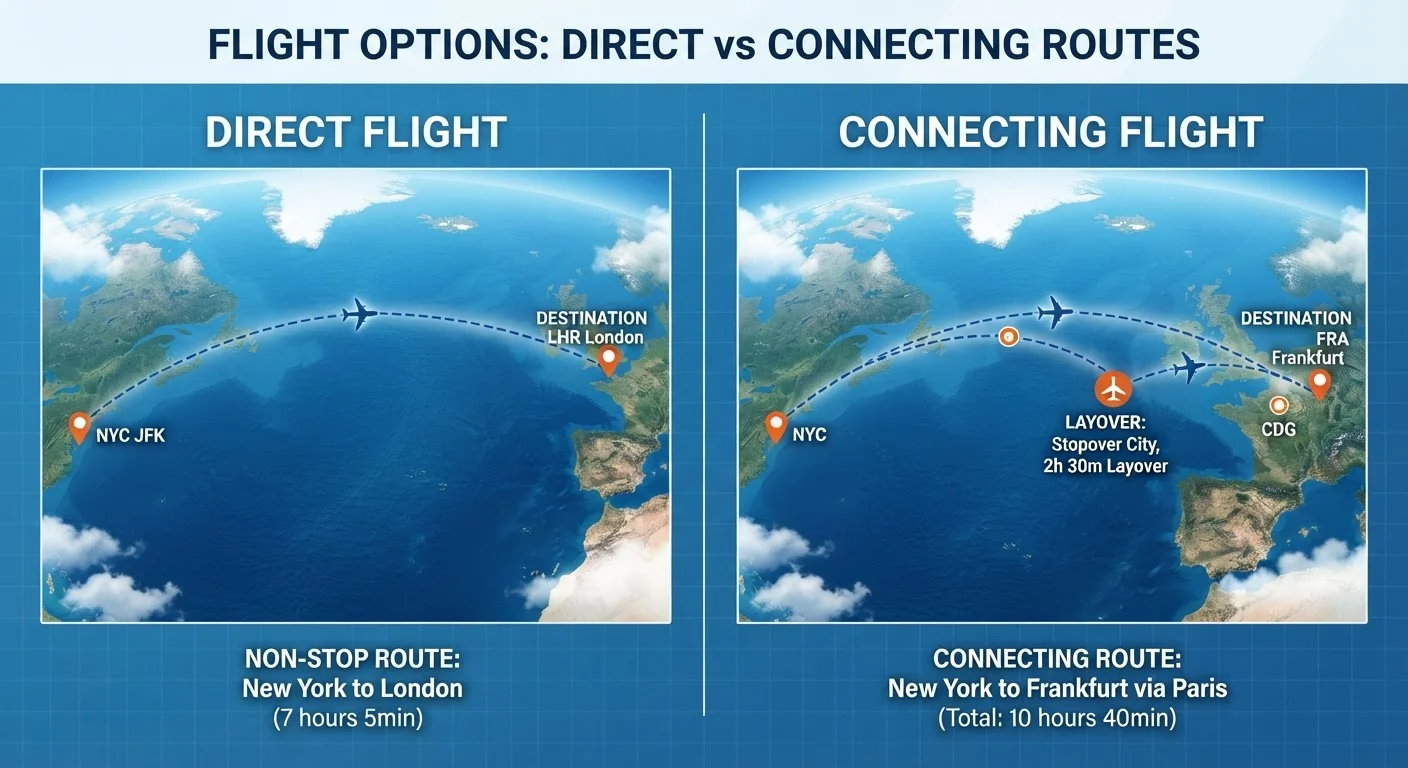
When booking a flight, the choice between direct and connecting itineraries isn't simply about price — it's about what you value most during travel. A direct flight goes from your departure city to your destination without a stop (or, in some cases, makes a stop without requiring you to change planes). A connecting flight requires at least one plane change at an intermediate airport before you reach your destination.
Understanding what each option actually costs you — in money, time, stress, and flexibility — is the foundation of a smarter booking decision. For a broader look at what shapes the price you see on any given itinerary, see our guide to airfare pricing factors.
Cost: When the Savings Are Real and When They're Not
Connecting flights are often cheaper because airlines use hub-and-spoke networks to fill seats on multiple legs simultaneously. Routes without nonstop service are almost always served only through a connection, so there's no direct comparison. But even on routes where both options exist, connecting itineraries can run significantly less — sometimes hundreds of dollars less on transcontinental or international trips.
That said, the savings aren't always as large as they appear. Factor in:
- Layover meals and airport costs — A 4-hour connection at a major hub can easily add $20–$50 in food and incidentals.
- Baggage fees per leg — Some low-cost carriers charge per segment rather than per trip.
- Potential rebooking costs — If you book two separate tickets (self-connecting), a missed connection is entirely your financial responsibility.
For routes where direct service exists, the price gap between nonstop and connecting flights tends to narrow. Use the cost difference as a starting point, but run the full math before assuming connecting is cheaper. Our article on when to book for the best fare can help you time your search more effectively.
| Direct Flights | Connecting Flights | |
|---|---|---|
| Typical Cost | Higher on most routes | Often lower, especially long-haul |
| Total Travel Time | Shorter, more predictable | Longer due to layovers |
| Missed Connection Risk | None | Moderate to high, depending on layover |
| Baggage Safety | Lower risk of misrouting | Higher risk with tight transfers |
| Route Availability | Limited to high-demand city pairs | Reaches more destinations |
| Comfort for Families/Seniors | Easier, less physically demanding | More complex, greater fatigue |
| Miles/Points Earning | Single segment earned | Multiple segments, more miles |
Time and Reliability: The Hidden Costs of Connections
A direct flight's time advantage is obvious, but it's easy to underestimate how dramatically a connection can extend total travel time. Add a 2-hour layover to a 3-hour flight and you've more than doubled your door-to-door travel block. On international itineraries, connections frequently add 4–8 hours or more.
Reliability is where direct flights earn their premium most clearly. Every connection introduces a new failure point: gate changes, late inbound aircraft, and weather delays at the hub can cascade into a missed connection. The shorter the layover, the higher the risk — most travel experts suggest a minimum of 60–90 minutes domestically and 2 hours internationally when booking connecting itineraries, though requirements vary by airport size.
Book Connecting Flights on a Single Ticket
Always book multi-leg itineraries on a single ticket rather than two separate bookings when possible. If the first leg is delayed and you miss your connection, the airline is obligated to rebook you at no cost when it's a single-ticket itinerary. Self-connecting across separate tickets transfers all rebooking risk — and cost — to you. Confirm this with your airline's terms before finalizing any split booking.
If you do opt for a connecting itinerary, longer layovers can sometimes work in your favor — providing buffer time, lounge access, or even a chance to explore a stopover city.
Baggage and Comfort Considerations
Checked bags are statistically more likely to be misrouted or delayed on itineraries with connections, simply because they must be transferred between aircraft on a tight schedule. Traveling carry-on only eliminates most of this risk. If you must check a bag, ensure your connection time exceeds the airline's minimum baggage transfer window — ask the airline directly if you're unsure.
Comfort during a long connection also matters. If you need to navigate a large airport between terminals, factor in walking time and potential shuttle rides. Our guide to navigating airport terminals can reduce transit stress at unfamiliar hubs.
For passengers with mobility limitations, health conditions, or young children, direct flights reduce physical strain and unpredictability significantly. Connecting flights place greater physical demands on travelers and introduce more logistical variables.
Making the Decision: A Practical Framework
Rather than defaulting to one option, weigh these questions before you book:
- How much is the price difference? A $30 gap rarely justifies the added risk of a connection. A $200+ gap may be worth it for leisure travelers with schedule flexibility.
- What's the purpose of the trip? Business travelers and those with firm arrival deadlines benefit most from direct routing.
- Are you booking on a single ticket or self-connecting? Separate-ticket connections offer no rebooking protection if a leg is missed.
- What's the layover airport? Some hubs are well-positioned for quick transfers; others are notorious for delays. Weather-vulnerable airports (e.g., Chicago, Denver in winter) add risk.
- What are your travel rewards goals? Connecting flights often earn more miles. If you're accumulating points strategically, see our comparison of travel points vs. cash back to understand whether the extra miles justify the extra time.
This article provides general travel planning information only. Flight prices, schedules, and policies vary by airline and change frequently — always verify details directly with your carrier before booking.