
Why Saving Feels So Hard to Start
Most people who have never saved consistently aren't lacking discipline — they're lacking a system. Saving feels abstract when bills are concrete and immediate. The brain naturally prioritizes present needs over future security, a well-documented behavioral tendency called present bias. Understanding this isn't an excuse; it's the foundation for designing a smarter approach.
There's also the intimidation factor. Personal finance content often leads with ambitious targets — three to six months of expenses in an emergency fund, 15% of income toward retirement — that feel unreachable to someone starting from zero. These are worthwhile long-term goals, but they're poor entry points. Unrealistic first steps kill momentum before a habit has a chance to form.
The good news: habits are built through repetition, not willpower. A small, repeated action — saving $20 every Friday — trains the behavior loop regardless of the dollar amount. If your budget is particularly stretched, see strategies tailored to constrained budgets for approaches designed around limited income.
Shifting Your Mindset Before Shifting Your Money
Before changing any numbers in your budget, two mindset shifts significantly improve your odds of success.
First, treat saving as a bill you pay yourself. When savings are optional — something you do with whatever remains at month-end — they rarely happen. Reframing your savings deposit as a non-negotiable monthly obligation puts it on equal footing with rent and utilities.
Second, separate identity from outcome. You don't need to "be good with money" before you start saving. You build the identity by doing the behavior — not the other way around. Early mistakes and small amounts are part of the process, not signs that saving isn't for you.
Present bias
The human tendency to give stronger weight to immediate rewards over future benefits, which makes saving — a future benefit — feel less urgent than current spending.
Emergency fund
A reserved pool of cash set aside specifically for unexpected expenses or income disruptions, kept separate from everyday spending money.
Automatic transfer
A scheduled, recurring movement of money from one account to another — such as checking to savings — that happens without requiring a manual action each time.
50/30/20 rule
A general budgeting guideline suggesting you allocate 50% of after-tax income to needs, 30% to wants, and 20% to savings and debt repayment. It's a starting framework, not a strict formula.
Habit loop
The cycle of cue, routine, and reward that reinforces repeated behavior over time. In savings, the cue is payday, the routine is transferring money, and the reward is watching the balance grow.
Reviewing your basic budget framework before setting a savings amount helps you identify a realistic number rather than guessing. The widely cited 50/30/20 guideline — 50% of after-tax income to needs, 30% to wants, 20% to savings and debt repayment — is a useful reference point, though it's a framework, not a rule. Adjust it to your actual circumstances.
Your First Goal: A Starter Emergency Fund
Your first savings target should be concrete, achievable, and purposeful: a starter emergency fund of $500 to $1,000. This modest cushion covers the most common financial shocks — a flat tire, an urgent dental visit, a broken appliance — without requiring a credit card or loan.
Research by the Urban Institute and others has found that having even a small liquid savings buffer substantially reduces the likelihood of falling into debt after an unexpected expense. The psychological benefit is equally important: knowing that buffer exists reduces financial anxiety and makes it easier to continue saving.
Once your starter fund is in place, the next milestone is typically one month of essential expenses, followed by the three-to-six month target you've heard about. But that progression happens over time. Right now, $500 to $1,000 is the goal.
Name Your Savings Account
Giving your savings account a specific label — "Emergency Fund" or "Safety Net" — in your banking app makes its purpose tangible. Studies in behavioral economics suggest that earmarking funds reduces the likelihood you'll spend them on unintended things. Most online banks and apps allow account nicknames at no cost.
Keep your emergency fund in a separate, named savings account — even labeling it "Emergency Only" in your banking app creates a psychological barrier that reduces impulsive withdrawals.
Making Saving Automatic and Effortless
The most effective structural change you can make is removing the decision from the process entirely. When saving requires a manual transfer each month, it competes with dozens of other financial decisions and loses more often than it should.
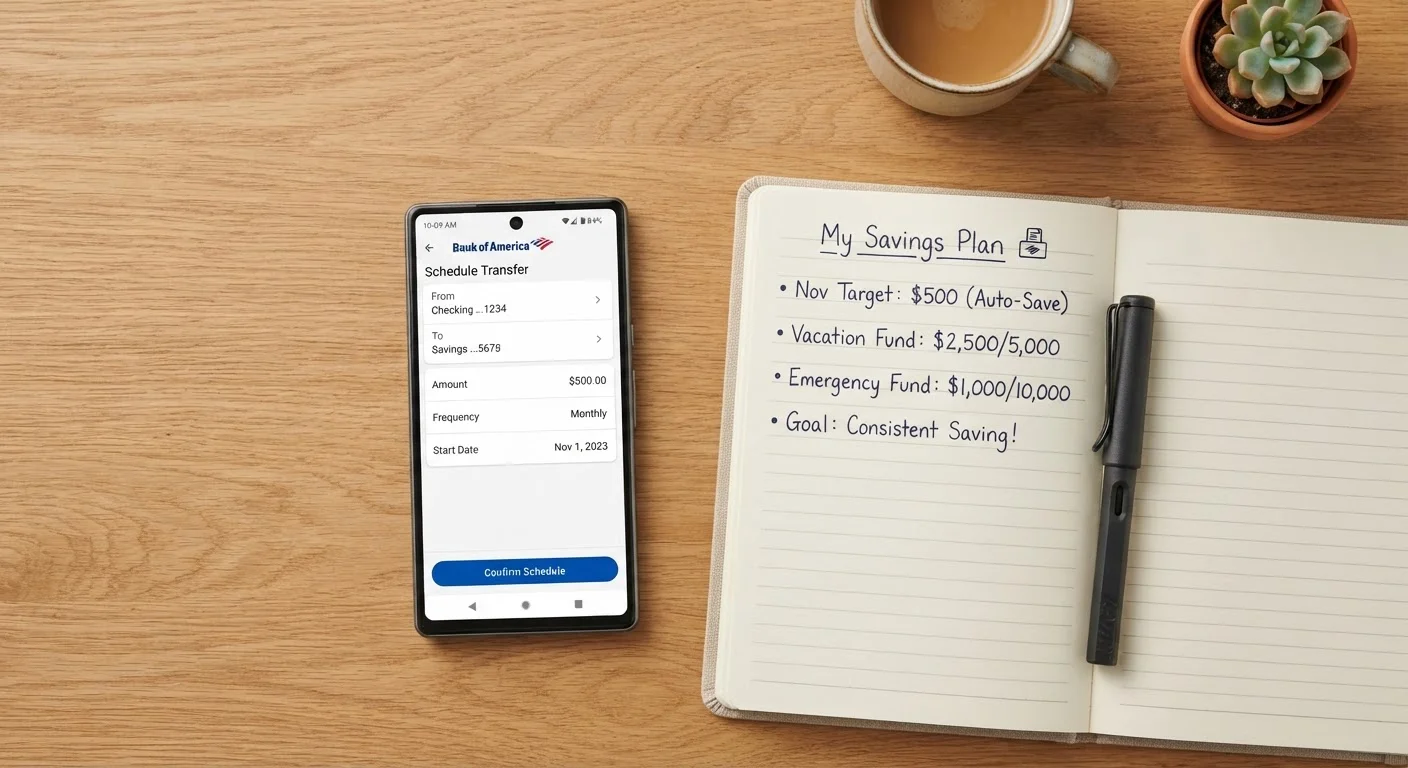
Most banks and credit unions allow you to schedule automatic recurring transfers from checking to savings on a date you choose — typically aligned with your payday. Even a fixed $25 or $50 per paycheck, moved automatically, compounds into meaningful progress over months. For a detailed walkthrough of how automation works in practice, see how to set up automatic savings transfers.
If your income varies — freelance work, hourly shifts, contract projects — a fixed automatic transfer may not always be feasible. Approaches for irregular-income earners offer percentage-based alternatives that flex with your cash flow.
Staying Consistent When Life Gets in the Way
No savings habit survives real life uninterrupted. You will miss a transfer. An emergency will drain the fund you just built. Income will dip unexpectedly. None of these events mean the habit has failed — they're the exact situations a savings habit is meant to help you navigate.
Two practices help maintain consistency over the long term. The first is a monthly money check-in: a 15-minute review of what you saved, what disrupted the plan, and what you'll adjust. This doesn't need to be elaborate — a notes app works. The second is removing guilt from the equation. Shame causes avoidance, and avoidance breaks habits far more reliably than a missed deposit does.
As your savings habit solidifies, you may also want to consider building your credit profile alongside it — strong savings and responsible credit use tend to reinforce each other. Our guide on building credit from zero covers foundational steps for those just starting out.
This article is for general informational and educational purposes only and does not constitute personalized financial advice. Readers should consult a qualified financial professional before making decisions specific to their financial situation.