
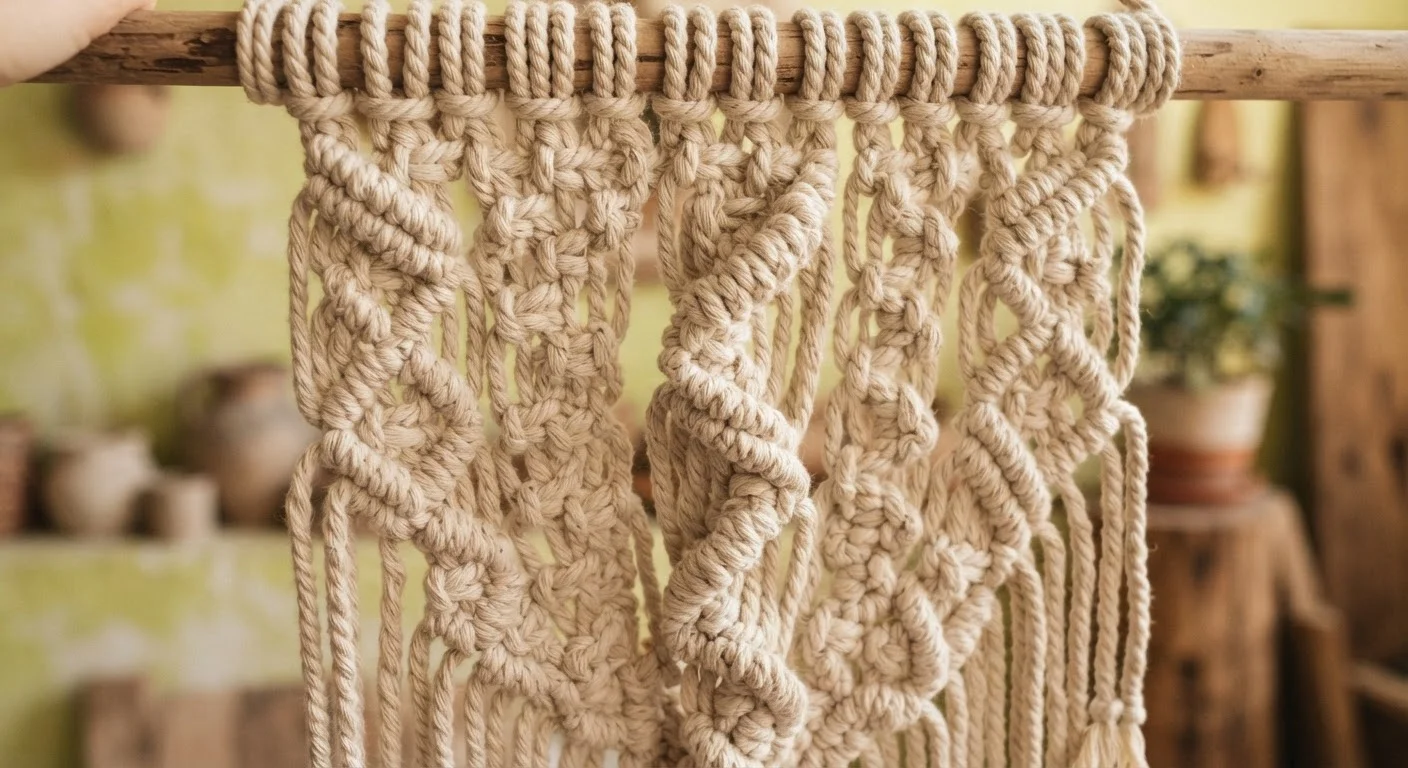
Why Knot Names Matter
Pick up almost any macramé pattern and you'll hit a wall of terminology within the first few lines: lark's head, double half hitch, alternating square knots. These aren't arbitrary labels — each name describes exactly how a cord moves, which makes them genuinely useful once you crack the code. Think of this guide as your go-to lookup sheet, whether you're mid-project or planning your first wall hanging.
| Craft category | Fiber art / textile knotting |
| Most foundational knot | Square knot |
| Most common mounting knot | Lark's head knot |
| Typical cord material for beginners | 3–5 mm twisted cotton rope |
| Knots needed for most beginner projects | 3–5 core knots |
| Spiral hitch also called | Half knot twist or half hitch spiral |
The good news? The vast majority of macramé projects — from simple plant hangers to elaborate wall art — rely on just a handful of repeating knots. Master these, and you'll be able to read almost any pattern with confidence.
The Core Knots You'll See Everywhere
Lark's Head Knot
This is almost always the first knot in any project. Fold a cord in half, loop the folded midpoint over a dowel or ring, then pull both loose ends through that loop and tighten. It creates a secure anchor point and is reversible — you can also mount it upside down (called a reverse lark's head) for a slightly different texture on the front face.
Square Knot
The workhorse of macramé. You work with four cords: two outer working cords and two inner filler cords. Tie a left-over-right half knot, then immediately follow with a right-over-left half knot to complete the square. Alternating square knots — where you shift which cords are working and which are filler between rows — create the classic diamond net pattern seen in most plant hangers.
Half Knot Spiral (Spiral Hitch)
Tie only the first half of a square knot repeatedly in the same direction. Because the knot is asymmetrical, the column naturally twists into a rope-like spiral. It's one of macramé's most satisfying visual effects and takes only one extra step once you know the square knot.
Double Half Hitch
A single working cord loops twice around a filler cord and pulls snug. Repeated across a row, double half hitches build clean horizontal, diagonal, or even curved lines — the primary tool for creating sharp geometric shapes. When worked diagonally in opposing directions, they form the signature chevron or V-pattern popular in wall hangings.
Gathering Knot (Wrapping Knot)
Used to bundle multiple cords together neatly — common at the top of plant hangers or at transition points in a design. One cord wraps tightly around the bundle several times, then the end threads back through the wraps and is pulled to hide it. The result is a clean, cylinder-shaped collar over the cords.
Reading Patterns Like a Pro
Working cord
The active cord you use to tie knots around other cords. It moves constantly while you work, as opposed to filler cords, which stay stationary.
Filler cord
The passive cord held taut while working cords are knotted around it. Also called a carrier cord, it forms the structural spine of many knot patterns.
Sennit
A chain or braid formed by repeating the same knot in sequence — for example, a column of square knots is called a square knot sennit.
Hitch
A category of knot in which one cord loops around and fastens to another cord or dowel. Half hitches and double half hitches are the most common in macramé.
Mounting cord
A horizontal or angled cord, ring, or dowel that working cords are attached to at the start of a project, usually using lark's head knots.
Fringe
The unworked, loose ends of cord left hanging below the final knots. Fringe can be trimmed straight, cut into a V-shape, or brushed out for a fluffy finish.
When a pattern says "tie a sennit of 6 square knots," it simply means repeat the square knot six times in a column using the same set of cords. When it says "work in alternating square knots for 4 rows," you shift the working cords by two between each row to stagger the knots like bricks.
Pay attention to cord direction cues — patterns often specify left-leaning or right-leaning double half hitches, which tells you which end the working cord starts from. Sketching the knot direction with a quick pencil arrow on your printed pattern can save a lot of unraveling.
If you're a visual learner, try tying each knot listed in this guide with a scrap length of cord before starting a new project. Muscle memory builds fast, and most knots click within a few practice rounds. From there, the language of macramé patterns stops feeling like a foreign alphabet and starts reading like a clear, satisfying set of instructions — one knot at a time.