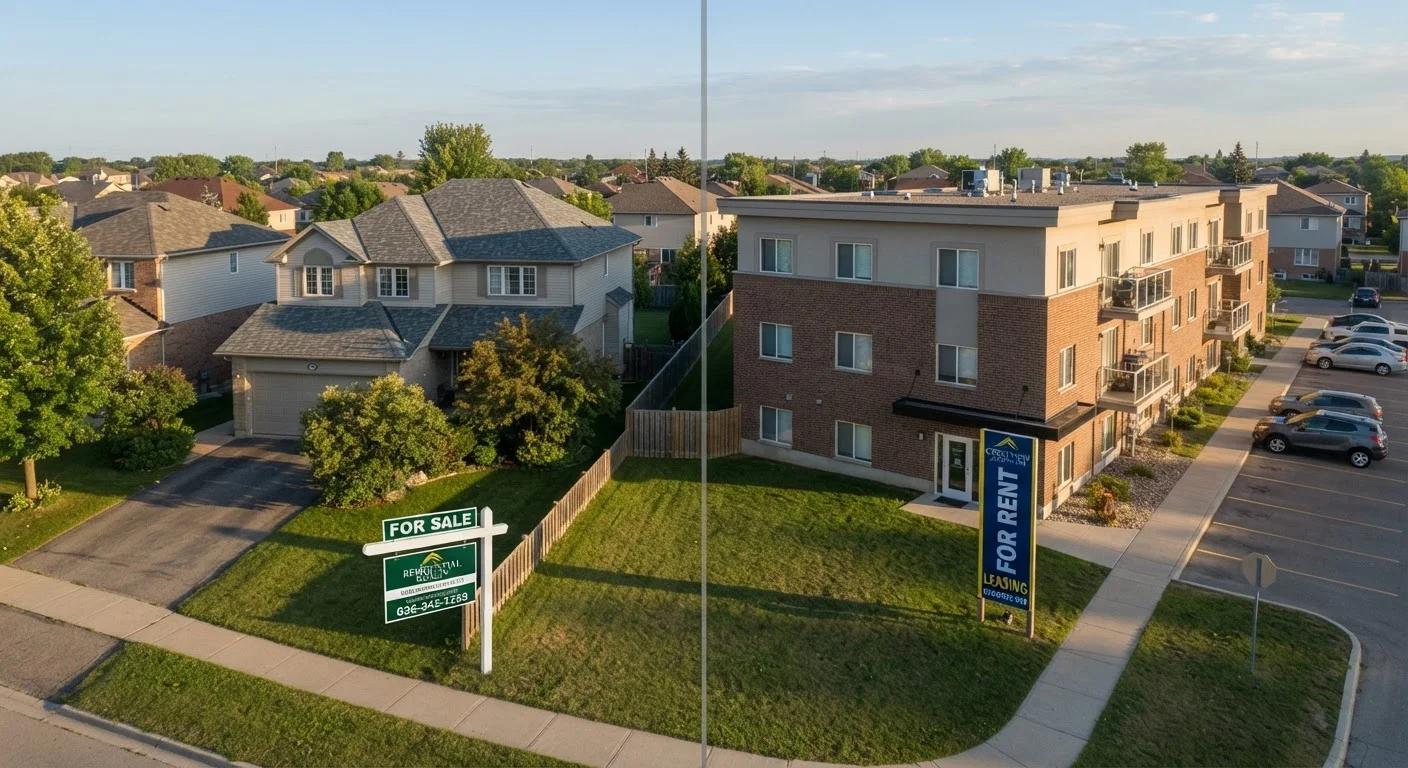

The Financial Reality of Each Path
The rent-vs.-buy debate is most often framed as a wealth-building question, but the math is rarely straightforward. Buying a home means accumulating equity — the portion of the home's value you own outright — as you pay down your mortgage and, ideally, as the property appreciates. However, transaction costs alone (closing costs typically run 2%–5% of the purchase price, plus agent commissions on the sale side) mean buyers generally need to stay in a home for several years before those costs are recouped.
Renters avoid those upfront burdens and retain liquidity — cash that could be invested elsewhere. The practical question is whether that capital is actually deployed productively. Renters who invest the difference between renting and ownership costs sometimes outperform buyers financially, but this depends on local price-to-rent ratios, investment discipline, and market timing — none of which are guaranteed.
| Renting | Buying | |
|---|---|---|
| Upfront costs | Security deposit, first/last month | Down payment, closing costs (2%–5%) |
| Monthly cost predictability | Rent can rise at renewal | Fixed-rate mortgage is stable |
| Equity building | None directly | Yes, over time |
| Maintenance responsibility | Landlord handles most repairs | Homeowner absorbs all costs |
| Flexibility to relocate | High — lease end or break clause | Low — selling takes months |
| Customization | Limited by lease terms | Full control (permit-dependent) |
| Legal protections | Landlord-tenant law, Fair Housing Act | Property rights, mortgage regulations |
| Market risk exposure | Rent increases, low vacancy | Price depreciation, interest rates |
For a deeper look at what conventional wisdom gets wrong about the financial side of buying, see Homebuying Myths That Catch People Off Guard.
What Renters Often Don't Know About Their Rights
Renting is not simply a lesser version of owning — it is a legal relationship governed by landlord-tenant law, and renters have enforceable protections that many never exercise. At the federal level, the Fair Housing Act prohibits discrimination based on race, color, national origin, religion, sex, familial status, and disability. Many states and localities extend protections further to cover source of income, sexual orientation, or age.
Security deposit rules vary by state but typically cap the amount a landlord can charge (commonly one to two months' rent) and set deadlines for returning it with an itemized accounting of any deductions. Habitability standards — covering heat, water, structural safety, and pest control — are implied in virtually every lease in the U.S., meaning a landlord cannot waive them contractually. When a landlord fails to maintain habitable conditions, renters in most states can pursue remedies such as rent withholding, repair-and-deduct, or lease termination.
Lease terms are also negotiable more often than renters realize. Before signing, it is reasonable to ask about rent increases, subletting rights, pet policies, and early termination clauses. If you're approaching a lease for the first time, our ground-up guide to finding and signing a lease covers the process in detail.
The Hidden Costs of Homeownership
Monthly mortgage payments are only part of what homeowners pay. Property taxes, homeowner's insurance, and — in many communities — HOA (homeowners association) fees add hundreds to the monthly cost. Maintenance and repairs are perhaps the most underestimated expense: industry guidelines suggest budgeting 1%–2% of a home's value annually for upkeep, though older homes or those in harsh climates can run higher.
Major systems — roofs, HVAC units, water heaters, plumbing — have finite lifespans and can require thousands of dollars in repairs or replacement with little warning. Unlike renters, who can call a landlord, homeowners absorb these costs directly. This financial exposure is real and should be factored into any honest comparison.
That said, homeownership does provide stability of housing costs that renting cannot always guarantee. A fixed-rate mortgage locks in a principal-and-interest payment for the life of the loan, whereas rents can rise at lease renewal. In high-demand rental markets, that predictability has real value.
Lifestyle Factors That Shift the Calculus
Financial analysis alone cannot settle this decision. Lifestyle factors carry genuine weight. Renting offers mobility — the ability to relocate for work, family, or personal reasons without the months-long process of selling a home. For people in careers with geographic uncertainty or those still figuring out which city they want to settle in, this flexibility is not a consolation prize; it is a structural advantage.
Ownership, on the other hand, enables customization. Homeowners can renovate, landscape, repaint, and modify their space without landlord approval (subject to local permits). For families who want stability in school districts or simply want to put down roots, that control has real quality-of-life value that doesn't appear in a rent-vs.-buy spreadsheet.
Market conditions also matter at a local level. In some metros, the price-to-rent ratio — a measure of home prices relative to annual rents — makes buying expensive relative to renting; in others, buying is comparatively affordable. A deeper analysis of these market-specific factors can help you run the numbers for your specific situation.
This article is for general informational and educational purposes only and does not constitute financial, legal, or investment advice. Readers should consult a licensed financial adviser, real estate attorney, or other qualified professional before making decisions based on their individual circumstances.