
Why Pooling Savings With Spending Creates Problems
Many people keep all their money in one or two accounts — a checking account for daily expenses and a single savings account that holds everything from an emergency fund to a vacation fund to a car repair cushion. On paper, it looks tidy. In practice, it creates a persistent problem: you rarely know how much of that balance is truly available to spend.
When savings and spending money share space, the boundaries blur. A $6,000 balance feels like $6,000 of spending power, even if $3,500 was earmarked for emergencies. Over time, this ambiguity leads to what behavioral economists sometimes call mental accounting failure — the gradual erosion of reserved funds through individually justified withdrawals that collectively undermine your financial safety net.
Separation addresses this directly. By assigning each savings goal its own account, you make the boundaries concrete rather than imaginary. The emergency fund has a balance. The house down payment has a balance. They can't accidentally be confused with each other or with your grocery budget.
If you share finances with a partner, the complexity compounds. See our guide to household budgeting for strategies on aligning goals when two people are involved.
The Pros of Keeping Savings in Dedicated Accounts
Structuring your savings across multiple purpose-specific accounts delivers several concrete advantages.
Prevents accidental spending of reserved funds
When your emergency fund occupies its own account, withdrawing from it requires a deliberate transfer — that friction alone stops many impulsive or casually justified withdrawals.
Makes goal progress immediately visible
A dedicated account labeled 'House Down Payment' with a $14,200 balance gives instant feedback on progress toward a goal, something a single pooled balance cannot provide.
Reduces decision fatigue through automation
Automatic transfers to named accounts remove the monthly temptation to delay saving 'just this once,' making consistent behavior the default rather than the exception.
Strengthens the pay-yourself-first habit
Routing savings to separate accounts before discretionary spending mimics the pay-yourself-first principle, one of the most effective structural changes a saver can make.
Earns more interest when placed in high-yield accounts
Savings in a dedicated high-yield account consistently outpace money left in a standard checking account, especially for reserves held over months or years.
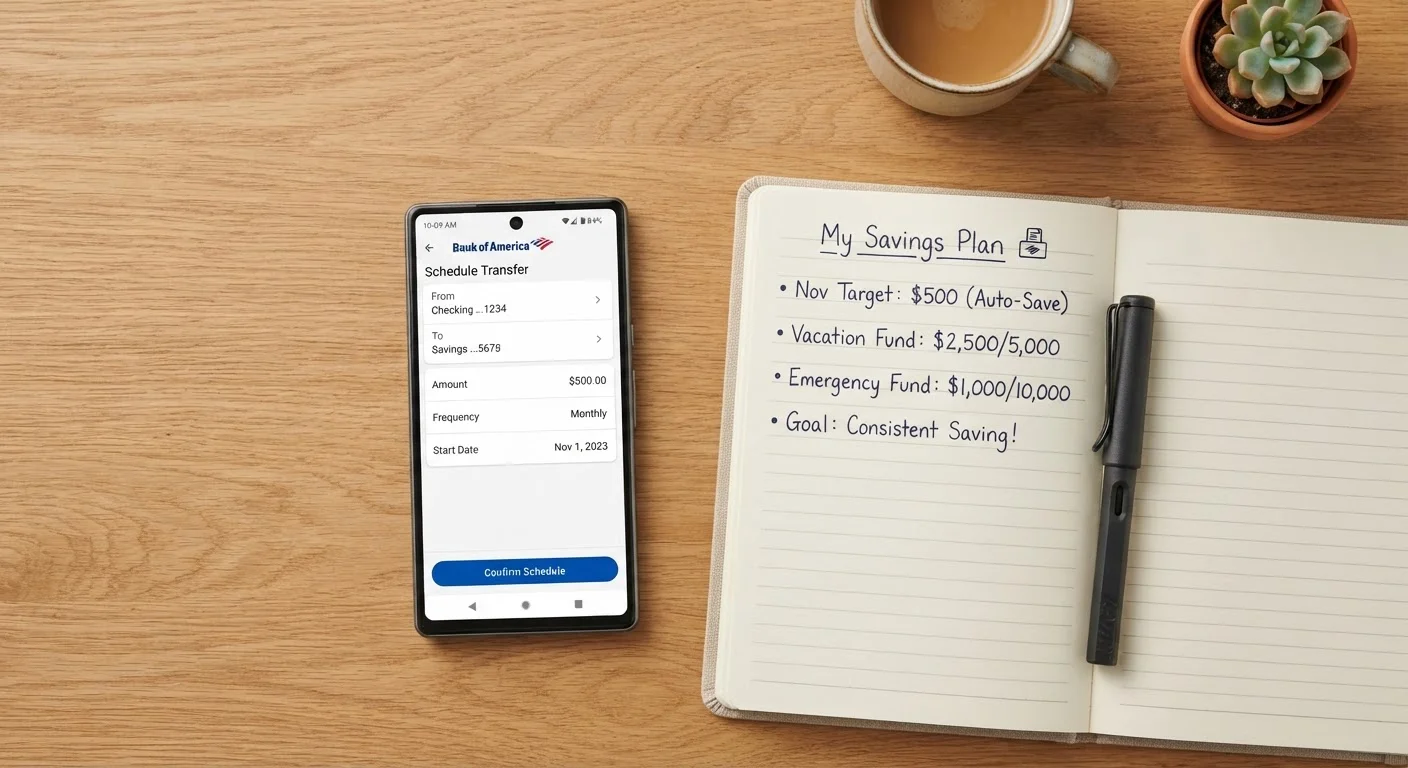
Automation amplifies these benefits considerably. When a fixed transfer routes directly from your paycheck into a labeled emergency fund account, saving stops being a decision you make each month and becomes a default outcome. Setting up automatic transfers is one of the most reliable ways to make this structure sustainable without relying on willpower.
Dedicated accounts also pair naturally with sinking funds — savings buckets for predictable future costs like car insurance renewals or annual subscriptions. Sinking funds work best when they're isolated from both your emergency reserve and your day-to-day spending.
The Cons: Where Account Separation Gets Complicated
A multi-account structure is not without genuine drawbacks. Understanding them helps you set up a system that works rather than one you abandon after a few weeks.
Managing multiple accounts adds administrative overhead
Monitoring several balances, tracking transfer schedules, and reconciling statements across accounts takes more effort than watching a single balance — though many banking apps consolidate this view.
Transfer delays can create short-term cash flow gaps
Moving money between institutions typically takes one to three business days, which can be inconvenient if you need emergency funds quickly or misjudge your checking balance.
Risk of over-segmenting into too many accounts
Creating separate accounts for every minor goal can become overwhelming and counterproductive; a system with too many buckets is often abandoned in favor of the simpler (but less effective) pooled approach.
Some accounts carry minimum balance requirements or fees
Spreading money across multiple accounts may cause individual balances to fall below fee-waiver thresholds, potentially generating monthly maintenance charges that eat into savings.
Transfer Timing: Plan for the Lag
Transferring money between accounts at different institutions can take one to three business days depending on the bank. If your emergency fund lives at a separate institution from your checking account, plan for that lag — it matters during an actual emergency. Keeping a small buffer in your checking account can bridge this gap without undermining your separation strategy.
Transferring money between accounts at different institutions can take one to three business days depending on the bank. If your emergency fund lives at a separate institution from your checking account, plan for that lag — it matters during an actual emergency.
How to Structure a Practical Multi-Account System
A workable structure doesn't require a dozen accounts. Most households function well with three to five purposeful buckets:
- Primary checking — receives income, pays fixed bills and daily expenses
- Emergency fund — three to six months of essential expenses, stored in a separate high-yield savings account and rarely touched
- Short-term sinking funds — for predictable irregular expenses (car maintenance, gifts, travel)
- Long-term goal savings — house down payment, major purchases with a timeline beyond one year
For the emergency fund specifically, consider whether a high-yield savings account or money market account better fits your access and yield preferences.
Choosing what to track within each account also matters. Whether you measure your progress as a fixed dollar target or as a percentage of income has real implications for motivation and accuracy. The savings rate vs. savings amount debate is worth understanding before you set your targets. And if your income varies month to month, irregular-income saving strategies can help you adapt this structure to an unpredictable paycheck.
This article is for general informational and educational purposes only and does not constitute personalized financial advice. Consult a qualified financial professional before making decisions about your own savings strategy.