
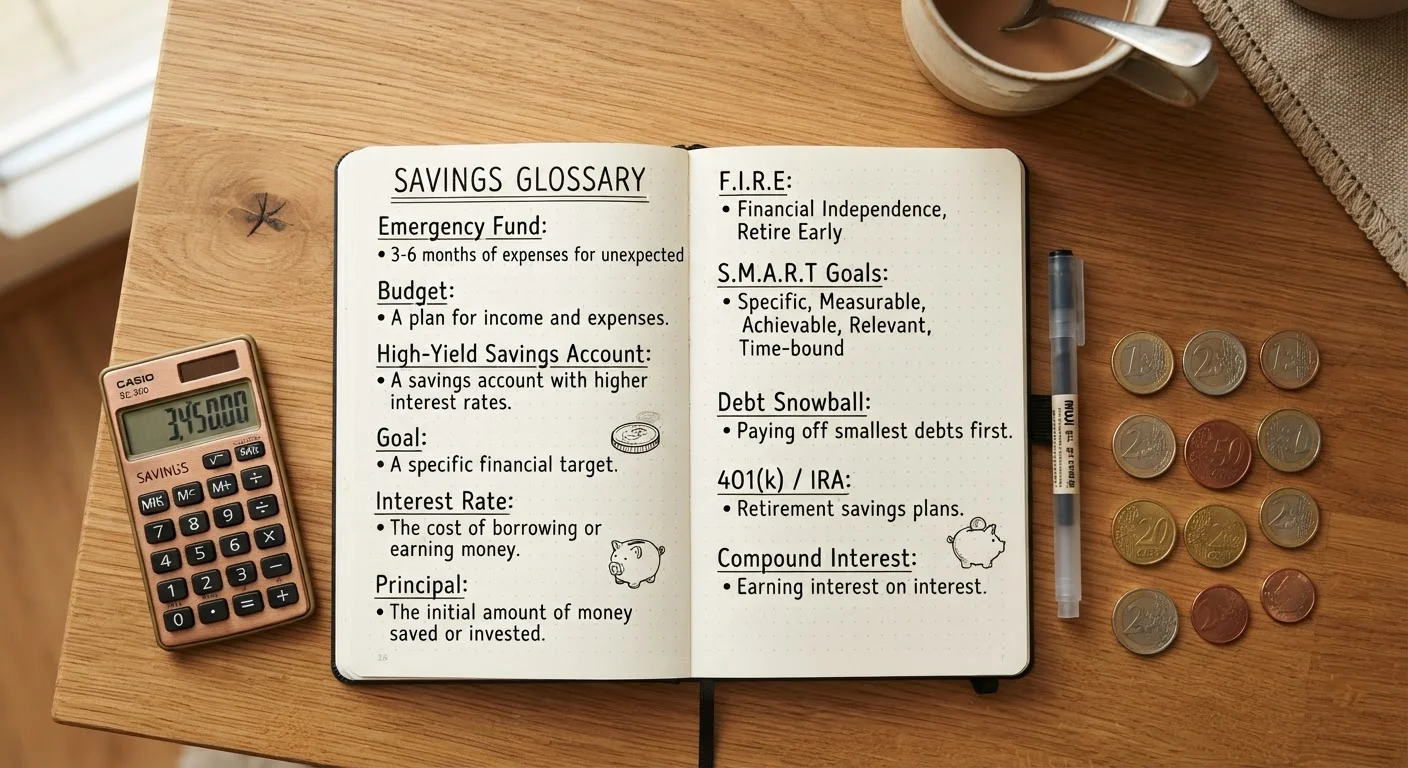
Why Savings Vocabulary Matters
When you open a savings account, compare rates online, or read a bank disclosure, you're confronted with a specific set of terms — APY, liquidity, FDIC insurance, compounding. These aren't just jargon. They describe real mechanics that affect how quickly your money grows, how safe it is, and how easily you can access it in an emergency.
This reference guide defines the savings terms you're most likely to encounter, in plain language. Whether you're building an emergency fund for the first time or reviewing an existing account, understanding these concepts puts you in control of the decisions you make. For a parallel glossary covering budgeting vocabulary, see Budgeting Terms Every American Should Know.
APY (Annual Percentage Yield)
The real rate of return earned on a savings account over one year, factoring in compounding. It is always equal to or higher than the stated interest rate and is the most useful figure for comparing savings accounts.
Compounding
The process by which interest earned on a balance is added back to that balance, so subsequent interest is calculated on a growing principal. The more frequently interest compounds, the faster savings grow.
Liquidity
A measure of how quickly and easily an asset can be converted to cash without losing value. Savings accounts are highly liquid; CDs and investments are generally less so.
FDIC Insurance
Federal protection on deposits at insured banks, covering up to $250,000 per depositor per ownership category per institution. Credit union equivalents are insured by the NCUA.
Emergency Fund
A dedicated cash reserve for unexpected financial disruptions such as job loss or medical expenses. Common guidelines suggest three to six months of essential expenses, though the right amount depends on individual circumstances.
Sinking Fund
Money set aside deliberately and incrementally for a specific, anticipated future expense. Unlike an emergency fund, a sinking fund has a defined goal amount and target date.
Savings Rate
The percentage of gross or net income that a person saves during a given period. It is a proportional metric that scales with income changes and is useful for tracking long-term savings habits.
Certificate of Deposit (CD)
A time-deposit account that holds funds for a fixed term — commonly three months to five years — typically at a higher interest rate than a standard savings account, with penalties for early withdrawal.
High-Yield Savings Account
A savings account that offers a significantly higher APY than the national average, often provided by online banks or credit unions. Funds remain liquid and FDIC- or NCUA-insured.
Money Market Account
A deposit account that typically offers higher interest rates than standard savings accounts and may include limited check-writing or debit privileges. It is distinct from a money market fund, which is an investment product.
Automatic Transfer
A scheduled, recurring movement of money between accounts set up through a bank or credit union. Commonly used to move funds from a checking account to a savings account on payday.
Principal
The original sum of money deposited or invested, before any interest or earnings are added. Interest calculations are based on the principal balance.
Core Terms Defined
Interest Rate vs. APY
The interest rate is the base percentage a bank pays you on your balance. APY (Annual Percentage Yield) accounts for compounding — the process by which earned interest is added to your principal, so future interest is calculated on a larger base. APY is almost always the more useful number to compare across accounts, because it reflects what you actually earn over a year.
Compounding Frequency
Interest can compound daily, monthly, or quarterly. More frequent compounding means slightly faster growth. A savings account that compounds daily at the same stated rate will produce a marginally higher APY than one that compounds monthly.
Liquidity
Liquidity describes how quickly and easily an asset can be converted to cash without significant loss of value. A standard savings account is highly liquid — funds are typically available within one to two business days. Certificates of deposit (CDs) are less liquid because withdrawing early usually triggers a penalty.
FDIC Insurance
The Federal Deposit Insurance Corporation (FDIC) is a U.S. government agency that insures deposits at member banks up to $250,000 per depositor, per ownership category, per institution. If a covered bank fails, insured deposits are protected. Credit unions offer equivalent protection through the NCUA (National Credit Union Administration).
Emergency Fund
An emergency fund is a dedicated cash reserve set aside specifically for unexpected expenses — job loss, medical bills, major car repairs. A widely cited guideline suggests three to six months of essential living expenses, though individual circumstances vary. For guidance on where to keep these funds, see High-Yield Savings Accounts vs. Money Market Accounts for Emergency Funds.
Sinking Fund
A sinking fund is money set aside in advance for a known, planned expense — a vacation, a new appliance, a car down payment. Unlike an emergency fund, a sinking fund has a specific target and timeline. Keeping sinking funds in separate accounts helps prevent unintentional spending. Learn more in Keeping Savings Separate.
Savings Rate
Your savings rate is the percentage of your income you save in a given period. It's a proportional metric that remains meaningful even as your income changes over time. Tracking this figure alongside your dollar savings amount gives you a fuller picture of your financial progress. The trade-offs between these two metrics are explored in Savings Rate vs. Savings Amount.
Automatic Transfer
An automatic transfer is a scheduled, recurring movement of funds from one account to another — typically from checking to savings — set up through your bank. Automating savings removes the temptation to skip a contribution. See how to structure this in Automating Your Savings.
This article provides general financial education and is not personalized financial advice. Consult a qualified financial professional for guidance specific to your situation.