How Each Lease Type Works
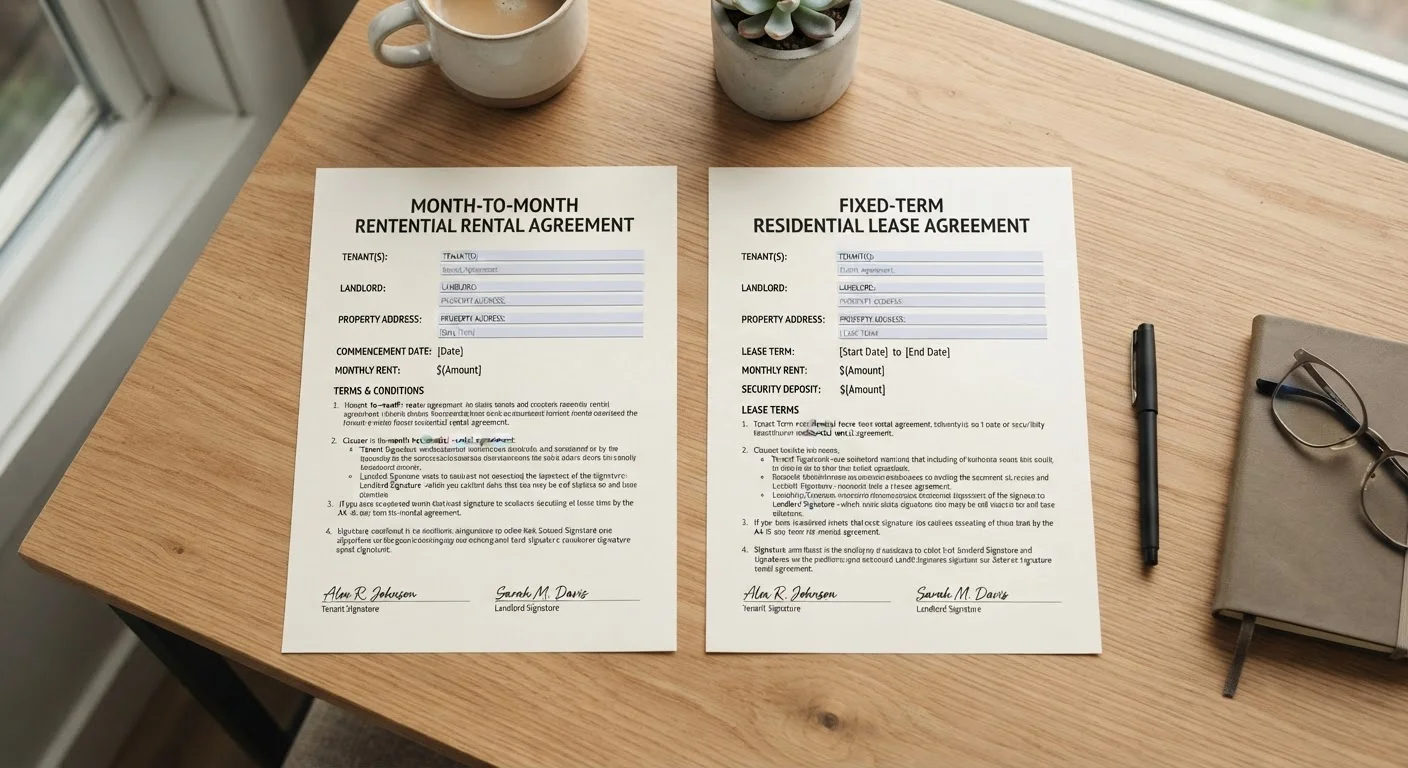
A fixed-term lease is a binding contract that sets a defined tenancy period — most commonly 12 months — during which neither the landlord nor the tenant can unilaterally change the core terms. Your rent is set at signing and cannot be raised until the term ends. In exchange, you're expected to occupy the unit for the full period; leaving early typically triggers penalties outlined in the lease.
A month-to-month lease (sometimes called a periodic tenancy) renews automatically at the end of each 30-day cycle unless either party provides proper written notice to terminate. There's no fixed end date. This arrangement offers mobility — but that flexibility cuts both ways. Landlords can also end the tenancy with relatively short notice, subject to state law.
Some month-to-month agreements begin that way; others arise when a fixed-term lease expires and the tenant stays on without signing a renewal. Understanding which situation applies to you matters because the governing terms may differ. See our guide to decoding lease clauses for help interpreting the specific language in your agreement.
| Criterion | Month-to-Month Lease | Fixed-Term Lease |
|---|---|---|
| Typical duration | Renews each month indefinitely | Set period, usually 12 months |
| Rent stability | Can change with proper notice | Locked in for the full term |
| Tenant exit notice | Typically 30 days written notice | Early exit may trigger penalties |
| Landlord termination | Possible with short notice | Generally not until term ends |
| Typical monthly cost | Often 10–20% higher | Generally lower rate |
| Best for market conditions | Falling or uncertain rents | Rising or competitive rents |
| Housing security | Lower — landlord can exit too | Higher during lease period |
Cost, Flexibility, and Stability Trade-Offs
Landlords routinely price month-to-month units at a premium — sometimes 10–20% above equivalent fixed-term rents — to compensate for the uncertainty of unpredictable vacancies. Over a year, that surcharge can add up to a meaningful sum. Fixed-term leases, by contrast, reward commitment: landlords gain occupancy certainty, and tenants gain a locked rate.
On the flexibility side, month-to-month tenants can typically exit with 30 days' written notice (some states require more). Fixed-term tenants who need to leave before the end date face a harder road. Early termination clauses vary — some require payment of two to three months' remaining rent; others require the tenant to cover costs until a replacement tenant is found. Our article on breaking a lease early covers tenant protections and damage-mitigation strategies in detail.
Stability also applies in reverse. Month-to-month tenants can receive a termination notice from their landlord with relatively little warning — in many states, just 30 days. In high-demand markets, this can leave renters scrambling. Fixed-term tenants are shielded from sudden displacement until the lease term ends.
10–20%
Typical month-to-month rent premium
Industry estimates suggest month-to-month units are commonly priced 10–20% above equivalent fixed-term rents to offset landlord vacancy risk.
30–60 days
Common termination notice required
Most U.S. states require 30 days' notice to end a month-to-month tenancy, though some states mandate 60 days or more depending on tenancy length.
12 months
Standard fixed-term lease length
The 12-month fixed-term lease is by far the most common rental agreement structure across the U.S. residential market.
Legal Rights and Notice Requirements
Both lease types are governed by state landlord-tenant law, and the rules vary considerably. Notice requirements for termination range from 30 days in many states to 60 or even 90 days in others, particularly for long-tenured month-to-month renters. Some cities layer additional protections on top of state law — including just-cause eviction requirements that restrict when a landlord can end a month-to-month tenancy at all.
Fixed-term leases offer stronger short-term eviction protection: landlords generally cannot force a tenant out before the end date without cause (such as nonpayment or lease violations). At expiration, however, the landlord can decline to renew on their own terms, which functionally ends the tenancy.
Rent control and rent stabilization ordinances — where they exist — may also interact differently with each lease type. Tenants in rent-stabilized units, for example, may retain the right to renew a fixed-term lease under local law. Always verify the rules in your specific city and state; tenant rights organizations and local housing authorities are reliable resources for jurisdiction-specific guidance.
If you're considering negotiating your lease terms, knowing which type of agreement you're being offered is the essential starting point.
This article provides general educational information about lease types and is not legal advice. Renter rights and landlord obligations vary by state and locality. Consult a qualified attorney or local tenant rights organization for guidance specific to your situation.