What Makes a Hard Inquiry 'Hard'?
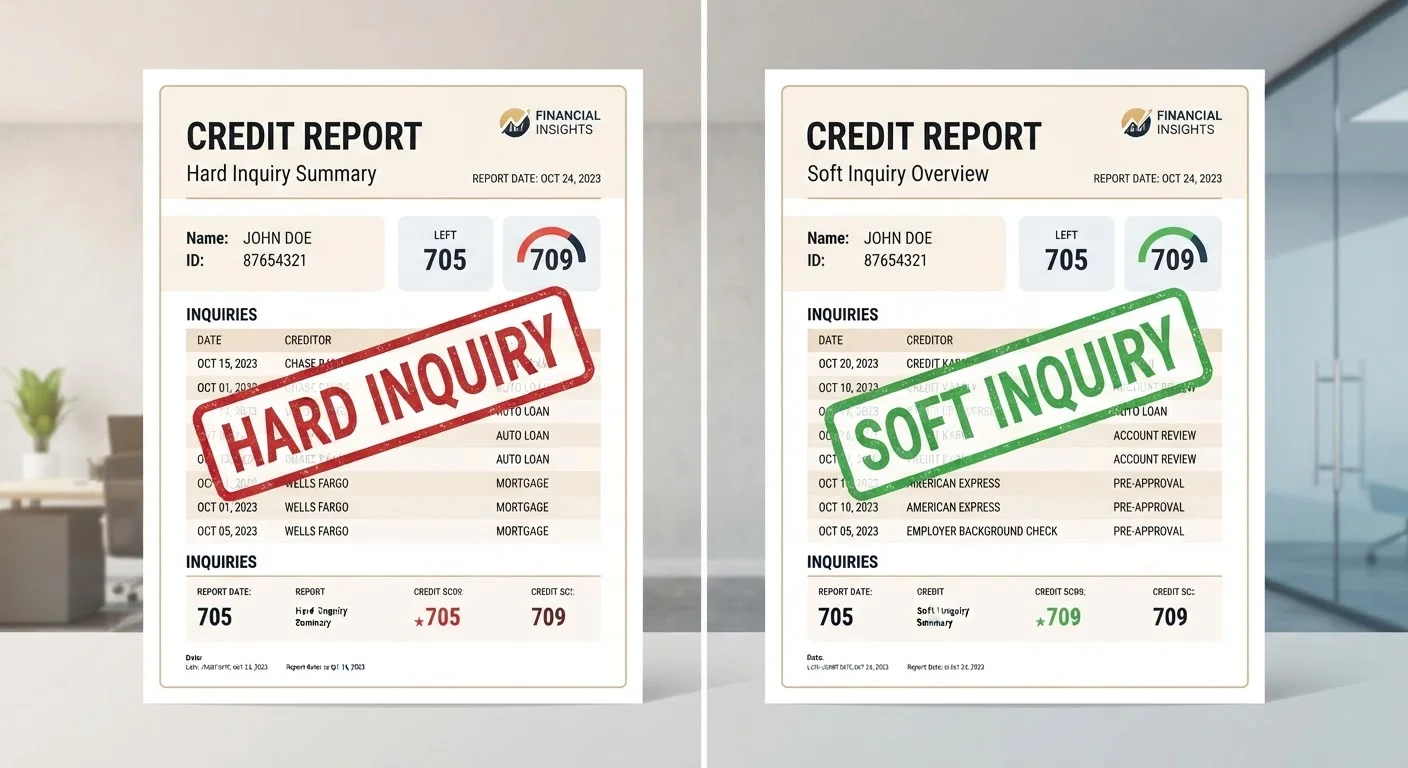
A hard inquiry — sometimes called a hard pull — occurs when a lender or creditor requests your full credit report to evaluate a formal application for credit. This is the type of check associated with applying for a mortgage, an auto loan, a personal loan, or a new credit card. Because you are actively seeking new credit, the inquiry signals a potential increase in your debt obligations, which is why scoring models treat it as a minor risk factor.
Hard inquiries are visible to other lenders who pull your report, and they remain on your report for two years. That said, their influence on your FICO score is limited to roughly the first 12 months. The score impact for a single inquiry is usually small — often fewer than five points — but multiple hard inquiries in a short span can accumulate. To understand how inquiries fit into the broader picture of your report, see our guide to the anatomy of a credit report.
Use Pre-Qualification Before You Apply
Many lenders offer pre-qualification tools that use a soft pull to give you an estimated rate and likelihood of approval. Taking advantage of these before submitting a formal application lets you compare options without generating a single hard inquiry. Only proceed to a full application once you've identified the offer that best fits your needs.
Soft Inquiries: The Invisible Checks
A soft inquiry — or soft pull — is any credit check that does not stem from a new application for credit. These checks are invisible to lenders reviewing your file and carry absolutely no weight in your credit score calculation. Common soft inquiries include:
- Checking your own credit report or score
- Pre-qualification and pre-approval screenings from lenders (when you haven't formally applied)
- Employer background checks
- Landlord tenant credit screenings
- Periodic account reviews by your existing creditors
One of the most persistent myths in personal finance is that checking your own credit hurts your score. It does not — ever. Our article on common credit score myths addresses this and several other widespread misunderstandings that can lead borrowers to make unnecessarily cautious — or uninformed — decisions.
Rate Shopping: When Multiple Hard Inquiries Work in Your Favor
Consumers shopping for a mortgage, auto loan, or student loan often worry that comparing rates across multiple lenders will devastate their score. In practice, major credit scoring models are designed to accommodate this behavior. FICO's scoring models group multiple inquiries for the same loan type made within a 14- to 45-day window and count them as a single inquiry. VantageScore uses a similar 14-day window.
This de-duplication does not apply to credit card applications. Each card application generates a separate hard inquiry with its own score impact, so it pays to be selective. Before submitting any formal application, running through a pre-application self-assessment can help you gauge your readiness and avoid unnecessary inquiries if approval is unlikely.
~10%
Share of FICO score from new credit inquiries
According to FICO's published scoring model breakdown, new credit — including hard inquiries — accounts for roughly 10% of a consumer's total FICO score.
<5 pts
Typical score drop from one hard inquiry
FICO notes that for most consumers, a single hard inquiry reduces a credit score by fewer than five points, with the effect fading after 12 months.
2 years
How long hard inquiries appear on your report
Hard inquiries are visible on your credit report for 24 months, though their influence on your FICO score is generally limited to the first 12 months.
How Inquiries Fit Into Your Overall Credit Health
Hard inquiries account for approximately 10% of a FICO score — a meaningful but relatively minor factor compared to payment history (35%) or credit utilization (30%). Keeping this proportion in perspective matters: a single hard inquiry is rarely the difference between approval and denial, but it can matter when your score is already borderline for a target credit score tier.
The type of credit you're applying for also shapes how lenders interpret your inquiry history. Applying for a mortgage after recently applying for several credit cards may give an underwriter pause, even if the score impact is minimal. Context matters alongside the numbers. If you're weighing different borrowing structures and how they might appear to lenders, our explainer on revolving credit vs. installment loans can provide useful grounding. For those building toward a borrowing milestone, managing inquiries deliberately is one straightforward, low-effort way to keep your credit profile clean.
This article is for general informational purposes only and does not constitute personalized financial, credit, or legal advice. Consult a qualified financial professional for guidance specific to your situation.