Why the Kiln Question Matters
Most people picture pottery as throwing clay on a wheel, loading a kiln, and pulling out a gleaming glazed mug days later. That image is accurate — but it leaves out a whole range of approaches that don't require a kiln at all. If you're new to clay work or just curious whether you can do it from your apartment or kitchen table, the good news is: yes, something genuinely satisfying is possible. The catch is that not all clay methods produce the same results, and understanding those differences will save you from a lot of surprised disappointment.
This comparison covers three realistic paths: air-dry clay, oven-bake clay, and community kiln access. Each has a distinct ceiling — and a distinct sweet spot.
Air-Dry Clay: The Easiest Entry Point
Air-dry clay hardens at room temperature over 24–72 hours, depending on thickness. No special equipment needed — just your hands, a smooth work surface, and some basic shaping tools. It's inexpensive, widely available at craft stores, and genuinely forgiving for beginners learning to build forms.
What it's good for: decorative items like pinch-pot bowls, wall hangings, figurines, jewelry, and sculptural pieces. Finished pieces can be painted with acrylic paint and sealed with a clear varnish for protection.
What it won't do: air-dry clay is porous and somewhat fragile. It is not food-safe, dishwasher-safe, or waterproof without sealing — and even sealed pieces shouldn't hold liquids for extended periods. Thin-walled projects tend to crack if dried too quickly. It also lacks the satisfying weight and durability of fired ceramics.
If you're setting up a dedicated space for clay work at home, see our guide to creating a small home creative workspace for practical setup tips.
Oven-Bake Clay: More Control, Different Trade-Offs
Oven-bake clays (sometimes called polymer clay) cure in a home oven, typically at temperatures between 215°F and 300°F. They stay workable until heated, which makes them ideal for detailed sculpting — miniatures, jewelry, buttons, ornamental objects.
Polymer clay is denser and more durable than air-dry clay once cured. It won't crack during the drying process the same way air-dry clay can, and it holds fine detail exceptionally well. Finished pieces can be sanded, buffed, painted, and varnished.
The limits are real, though. Oven-bake clay is not food-safe and shouldn't be used for dishes, mugs, or anything that touches food. It also can't be used to throw on a wheel — it's a hand-sculpting medium. And while it cures at low temperatures, the fumes produced during baking mean good ventilation matters.
| Air-Dry Clay | Oven-Bake Clay | Community Kiln Access | |
|---|---|---|---|
| Equipment needed | None | Home oven | Studio/kiln access required |
| Food-safe results | No | No | Yes (with appropriate glaze) |
| Durability | Low — fragile | Moderate | High |
| Best for | Decorative objects, sculpture | Jewelry, miniatures, detail work | Mugs, bowls, functional ware |
| Upfront cost | Very low | Low to moderate | Moderate (studio fees vary) |
| Wheel throwing possible | No | No | Yes |
| Beginner-friendliness | Very high | High | Moderate — some learning curve |
Community Kiln Access: The Real Ceramic Experience
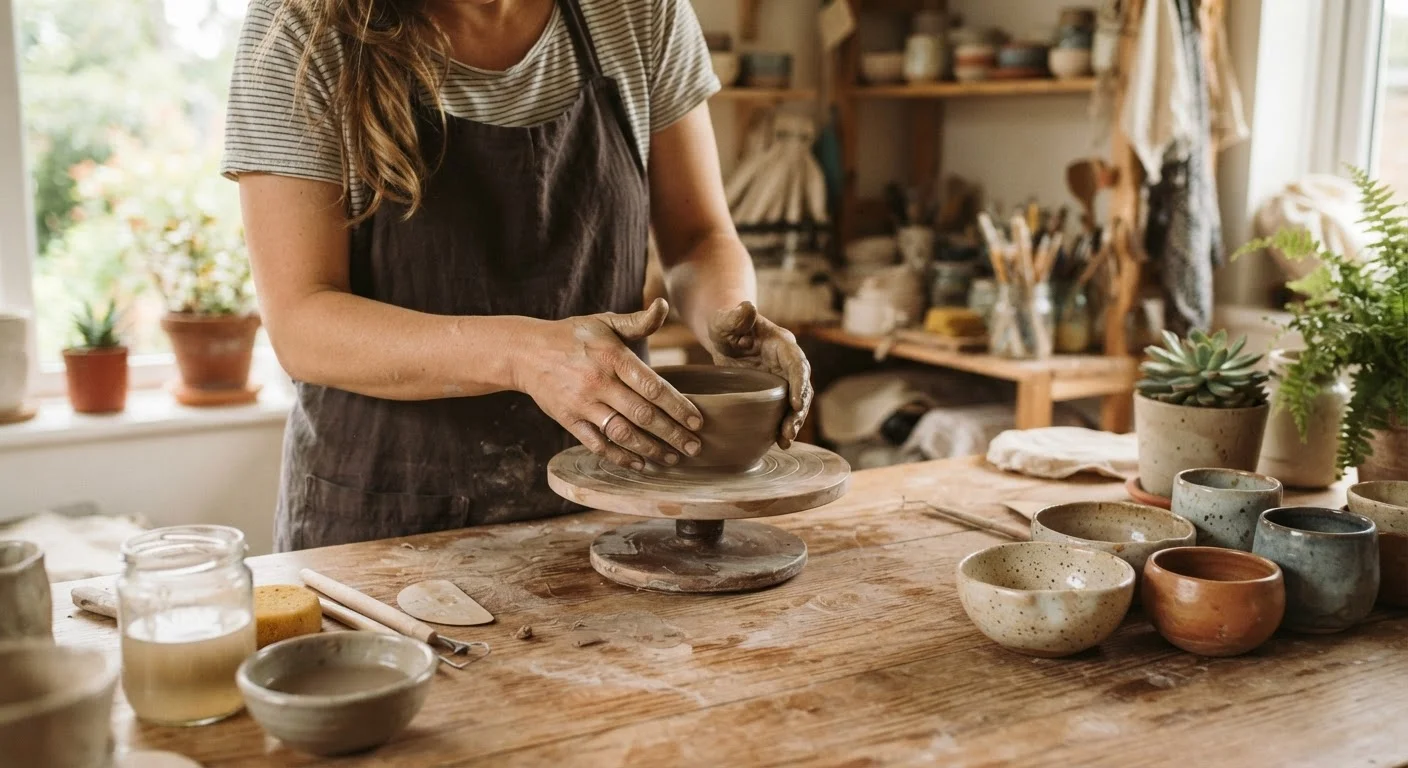
If your goal is true, fired ceramics — pieces that are durable, potentially food-safe, and glazed in the traditional sense — a community kiln is the honest answer. Many cities have ceramics studios, community arts centers, or maker spaces that offer open studio time, kiln firing fees, and sometimes wheel access for a modest hourly or membership rate.
This path requires more planning and investment of time than working at home, but it opens up the full range of ceramic possibilities: earthenware, stoneware, porcelain, and a wide palette of glazes. Results are structurally stronger and more durable than anything achievable without firing.
Worth noting: firing fees, studio time costs, and clay costs vary widely by location. Some studios include clay and glazes in membership fees; others charge separately. It's worth calling ahead to understand what's included before committing.
Prefer working independently? Pottery is one hobby that's harder to take on the road — but if you're curious about which creative pursuits do travel well, our piece on creative hobbies that thrive away from home is worth a read.
Choosing the Right Approach for You
The choice comes down to three honest questions: What do you want to make? How much time and money are you willing to invest? And how important is durability and food-safety to you?
- Decorative, expressive projects on a tight budget: Air-dry clay is your starting point. Low stakes, low cost, surprisingly versatile for non-functional work.
- Detail sculpting and jewelry making: Oven-bake clay gives you more precision and durability, with the added flexibility of staying workable until you're ready to cure it.
- Functional dishware, mugs, or serious ceramics: Community kiln access is the only realistic path. The results are in a completely different category.
There's no wrong entry point — plenty of people who start with air-dry clay eventually find their way to a local ceramics studio and never look back. The most important step is simply starting.