
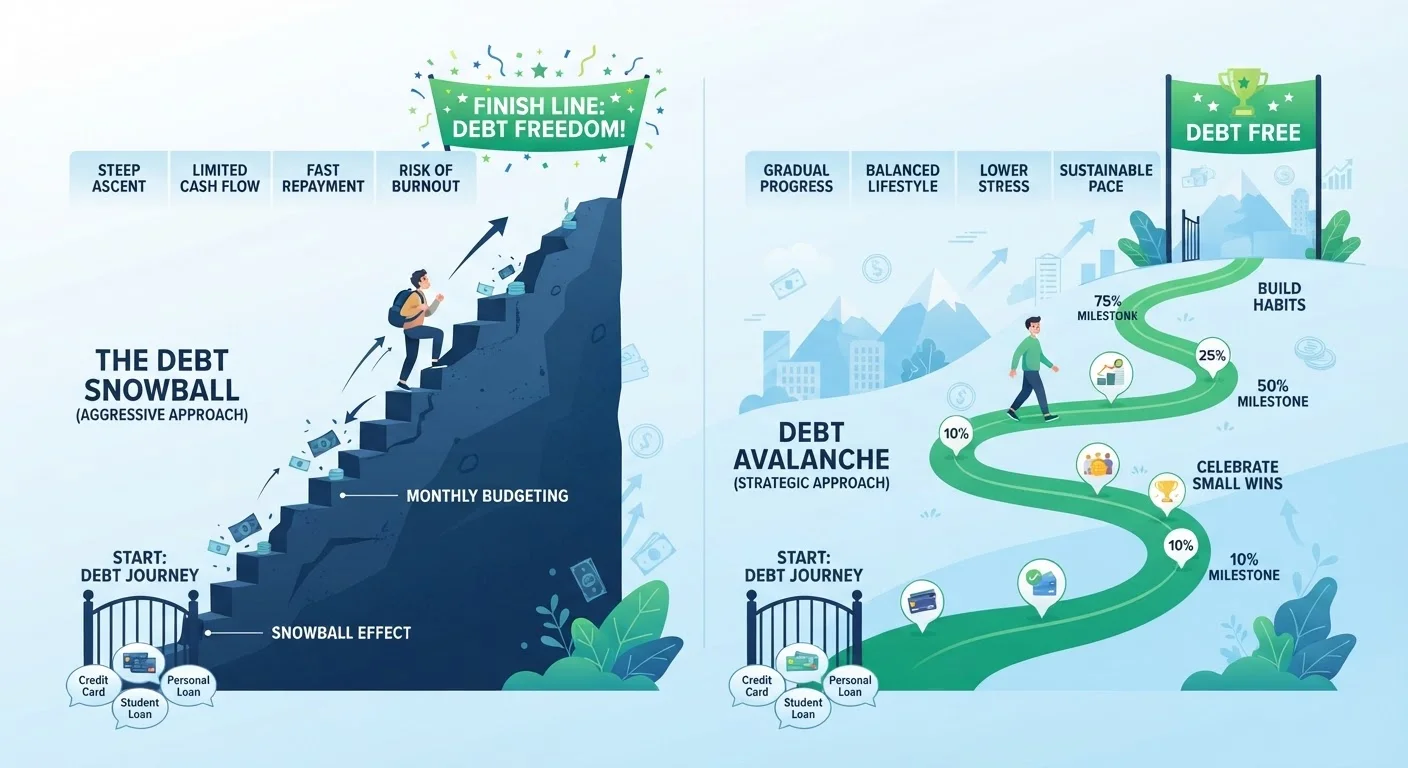
How Each Strategy Works
Both the debt avalanche and debt snowball are structured debt repayment frameworks. They share the same core mechanic: you make minimum payments on all debts, then direct any extra money toward one targeted account. The difference is which account gets that focus.
Debt Avalanche: You rank your debts by interest rate, highest to lowest. Every extra dollar goes toward the highest-rate balance until it's gone, then you roll that payment to the next-highest rate. This approach directly attacks the most expensive debt first.
Debt Snowball: You rank debts by outstanding balance, smallest to largest. Extra payments go toward the smallest balance first, regardless of its interest rate. Once that account is paid off, you redirect its payment to the next-smallest — building momentum like a snowball rolling downhill.
Before choosing a strategy, it helps to understand what kinds of debt you're carrying. Secured and unsecured debts behave very differently, and knowing the distinction can sharpen your payoff plan.
The Math: Which Method Costs Less?
In nearly every scenario, the debt avalanche results in less total interest paid. Because you're eliminating high-rate balances first, less interest accrues on those accounts over time. The difference can be meaningful — sometimes hundreds or even thousands of dollars — depending on your balances and rates.
Consider a simplified example: if you have a $5,000 credit card at 22% APR and a $1,200 medical bill at 0% interest, the avalanche directs extra payments to the credit card while you pay only the minimum on the medical bill. The snowball does the opposite, clearing the medical bill first. The snowball costs you more in this case because the high-interest debt keeps accruing charges longer.
| Debt Avalanche | Debt Snowball | |
|---|---|---|
| Priority order | Highest interest rate first | Smallest balance first |
| Total interest paid | Lower in most scenarios | Higher when rates vary widely |
| Time to first payoff | Longer if top debt is large | Faster — smallest balance clears quickly |
| Motivational design | Rewards patience and discipline | Provides quick wins and momentum |
| Best debt profile | Wide spread in interest rates | Many small balances or similar rates |
| Behavioral risk | May feel slow without early wins | Costs more if motivation isn't the issue |
The gap narrows when interest rates across your debts are similar, or when a small-balance debt also carries a high rate — in those cases, both methods may recommend the same order anyway.
The Psychology: Which Method You'll Actually Finish
Financial behavior research consistently shows that motivation and perceived progress matter enormously to debt repayment outcomes. The debt snowball is specifically designed to exploit this: eliminating a whole account — even a small one — delivers a concrete sense of accomplishment that can reinforce the habit of repayment.
For people who feel overwhelmed by multiple balances, reducing the number of accounts quickly can make the overall debt feel more manageable. Fewer payments to track also reduces cognitive load and the chance of missing a due date.
The avalanche, by contrast, can feel unrewarding early on if your highest-rate debt also carries a large balance. Months of extra payments with no account fully closed can erode discipline over time.
Hybrid Approach: Blend Both Methods
If you have one very small balance and several high-rate accounts, consider paying off the tiny balance first for a quick win, then switching fully to the avalanche order. This one-time hybrid move captures motivation benefits without meaningfully sacrificing the math. Just be deliberate — avoid hopping between methods repeatedly, as consistency is what drives results.
Understanding how different loan types affect your credit and financial picture — including revolving credit versus installment loans — can help you prioritize which debts deserve the most attention.
Choosing the Right Approach for Your Situation
There is no universal answer, but a few questions can guide your decision:
- How much does interest rate spread matter? If your rates vary widely — say, a 5% car loan alongside a 24% credit card — the avalanche's math advantage is significant. If rates are clustered closely together, the difference is smaller.
- How many accounts do you carry? A borrower juggling six or seven balances may benefit most from the snowball's account-elimination momentum.
- What's your track record with financial goals? If you tend to abandon plans before seeing results, the snowball's early wins may be more valuable than the avalanche's long-term savings.
Either strategy works best when paired with a sound budget. See how structured budgeting frameworks compare in our look at zero-based budgeting versus the 50/30/20 rule, and explore responsible borrowing habits that make repayment more sustainable long-term.
For a broader grounding in credit and debt concepts, this complete overview covers the full landscape of borrowing responsibly.
This article is for general informational and educational purposes only and does not constitute personalized financial, tax, or legal advice. Consult a qualified financial professional before making decisions about your specific debt situation.