Why Indoor Enrichment Matters More Than You Think
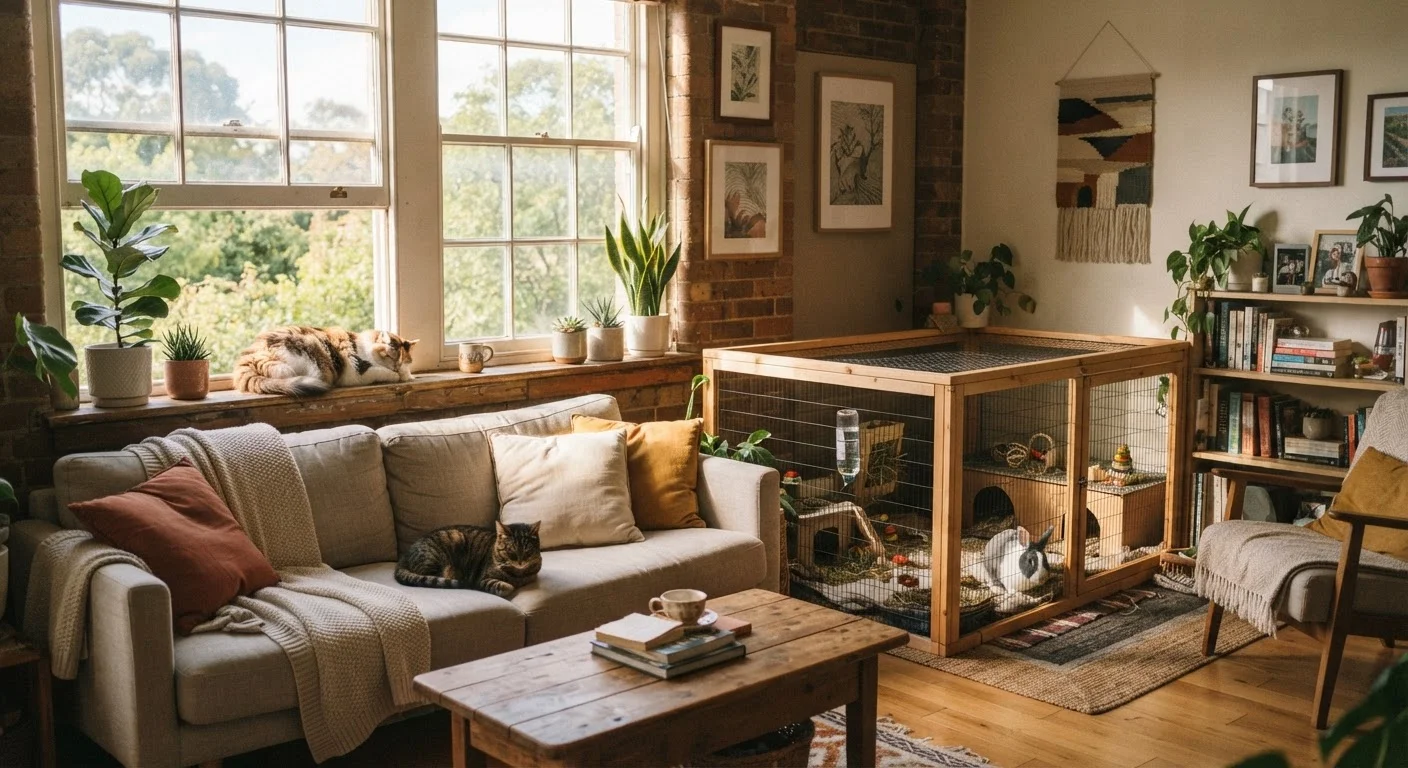
Indoor living offers pets safety from predators, traffic, and disease — but it also removes the unpredictability that wild and semi-wild animals are neurologically wired to experience. Without mental challenges, many pets develop what animal behaviorists call boredom-driven behaviors: destructive chewing, excessive vocalization, over-grooming, or repetitive pacing. These aren't signs of a bad pet — they're signs of an under-stimulated one.
Research in applied animal behavior consistently shows that cognitive engagement and sensory variety are as important to an animal's quality of life as food and physical activity. The good news: you don't need a large home or expensive equipment to provide meaningful enrichment. You need thoughtful design and a little daily intention. If you're still deciding which pet best fits your living situation, our guide on matching pets to your living space is a helpful starting point.
The strategies below apply broadly across dogs, cats, and small animals like rabbits, guinea pigs, and birds — with species-specific notes where it matters.
Use Puzzle Feeders Instead of Food Bowls
One of the most researched and accessible forms of enrichment is food-based cognitive challenge. In the wild, animals work for their meals — sniffing, foraging, problem-solving. A standard food bowl eliminates all of that in seconds.
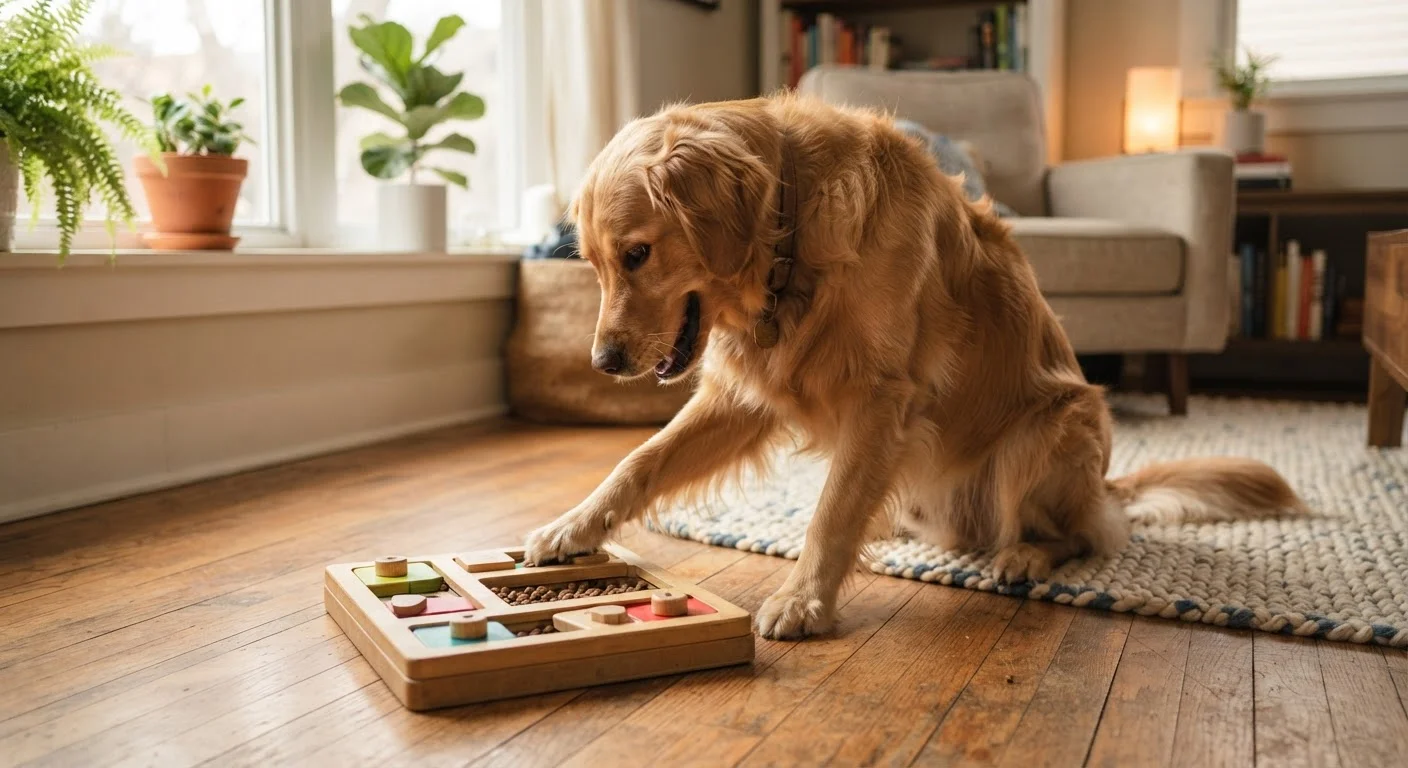
Puzzle feeders — containers that require manipulation to release food — make mealtime mentally engaging. Options range from simple rubber toys with food stuffed inside to multi-step sliding compartment boards. For cats, try hiding small portions of food in several locations around the home to encourage natural hunting behavior. For rabbits and guinea pigs, scatter-feeding hay or hiding leafy greens in foraging mats works well.
Start with easier puzzles and increase difficulty gradually. If a pet gives up quickly, the puzzle may be too hard for their current skill level — frustration isn't enrichment.
Making animals work for food taps directly into their natural foraging instincts.
Introduce Scent Work and Nose Games
A dog's nose contains roughly 300 million olfactory receptors compared to a human's 6 million. For cats and small mammals, scent is equally central to how they interpret the world. Nose work — structured or informal activities that require the animal to locate a hidden scent — is one of the most tiring and satisfying forms of mental exercise available to indoor pets.
For dogs, start by hiding a favorite treat under one of several cups and encouraging them to sniff it out. Graduate to hiding treats in multiple rooms. For cats, rotate different safe herbs (dried catnip, valerian, or silver vine) placed inside paper bags or cardboard rolls. Even rabbits respond well to foraging challenges that engage their sense of smell.
Ten to fifteen minutes of structured nose work can be more mentally tiring than a thirty-minute walk for many dogs — particularly useful on days when outdoor exercise isn't possible.
Scent work can be more mentally exhausting for dogs than a long physical walk.
Create Vertical Space and Safe Exploration Zones
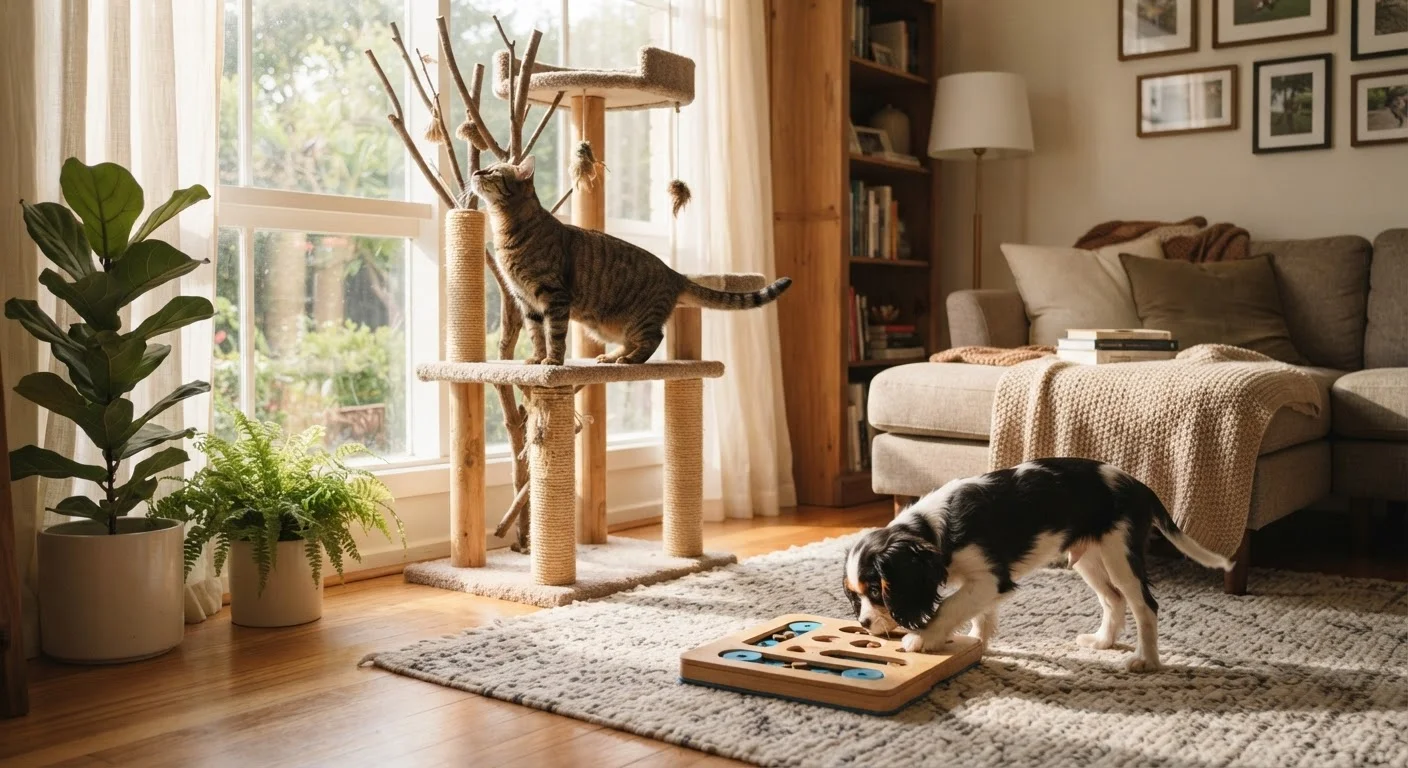
Cats are vertical animals. Without elevated perches, they lose access to a fundamental part of their behavioral repertoire — surveying territory, retreating from perceived threats, and simply resting with a wide field of view. Vertical space is not a luxury for cats; it's a welfare need.
Cat trees, wall-mounted shelves, and window perches with bird feeders visible outside all provide meaningful environmental variety. Window access — even through a screened window — introduces shifting sounds, scents, and visual stimuli that change throughout the day.
For dogs and small animals, this translates to safe exploration zones: a dog-safe room with different textures to walk across, a rabbit's supervised access to a new area of the home, or a bird's time outside its cage in a secure, monitored space. Novelty in physical space is enrichment in itself.
For cats, vertical space is a welfare need, not an optional upgrade.
Rotate Toys on a Weekly Schedule
Pets habituate to familiar objects quickly — the toy that sparked excitement on Monday becomes invisible by Friday. Rotating toys on a weekly or biweekly schedule keeps items feeling new without requiring constant purchases.
Store a portion of toys out of reach and swap them in regularly. When an old toy reappears after two weeks, many pets engage with it almost as enthusiastically as they did the first time. This is especially effective for cats with feather wands and crinkle toys, and for dogs with rope toys or squeaky objects.
A smaller collection rotated strategically provides more stimulation than a large collection that's always available. Scarcity and novelty drive engagement.
A rotated toy collection delivers more engagement than a large permanently available one.
Build in Social and Training Engagement Daily
Structured interaction — even five to ten minutes of intentional training — provides cognitive challenge, strengthens the human-animal bond, and gives pets a sense of purpose and accomplishment. This applies beyond dogs: cats can learn cue-based behaviors, parrots thrive on daily interactive communication, and even rabbits can be trained to respond to simple signals using positive reinforcement.
For dogs, rotating through known cues in novel combinations is more mentally engaging than drilling the same sequence. Add environmental variables: practice a "sit" in a different room, on a different surface, or with mild distractions present.
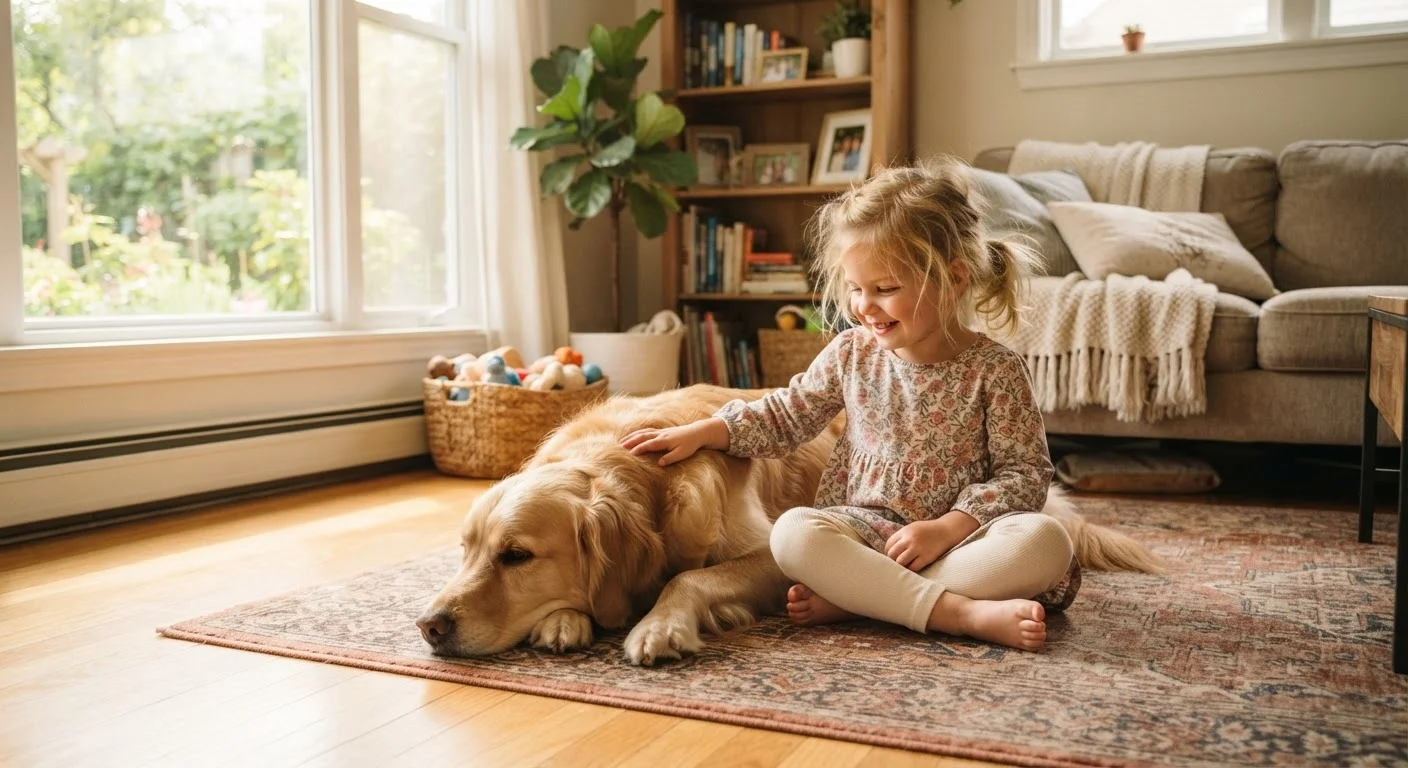
Social enrichment also includes calm companionship — sitting near your pet while reading, talking softly, or simply being present. Isolation is one of the most common drivers of stress in social species, and your consistent presence is itself a form of enrichment.
Even five minutes of intentional daily training gives pets cognitive challenge and a sense of purpose.
Offer Species-Appropriate Sensory Variety
Different animals prioritize different senses, and enrichment works best when it targets those priorities. Sensory enrichment means deliberately varying the sounds, textures, scents, and visual stimuli available in your pet's environment.
For birds, nature sound recordings or species-appropriate ambient audio can provide auditory stimulation. For cats, a bird feeder placed outside a window creates what behaviorists sometimes call a "kitty TV" — hours of unpredictable visual activity. For small mammals like hamsters or gerbils, nesting materials with varied textures (paper, hay, cloth strips) support natural burrowing and building behavior.
Even something as simple as placing a pet-safe herb like rosemary or basil near a cat's resting area introduces olfactory novelty. Sensory variety doesn't require complexity — it requires intentional variety.
Targeting a pet's dominant sense is the most efficient path to meaningful enrichment.
Building a Richer Routine
Enrichment isn't a one-time project — it's an ongoing practice. The most impactful thing you can do is build small enrichment moments into your pet's daily routine rather than relying on a single big activity. Pets, like people, benefit from predictability paired with novelty: a reliable schedule that still surprises them in low-stakes ways.
Start Small and Build Gradually
If your pet isn't used to enrichment activities, introduce one new element at a time rather than overhauling their environment all at once. Too much novelty too quickly can cause stress rather than engagement, particularly in anxious or older animals. Observe your pet's response and adjust the challenge level based on their comfort and enthusiasm.
If you're seeing problem behaviors despite daily exercise, enrichment is often the missing piece. Our companion article on enrichment activities that reduce problem behaviors goes deeper on the behavioral science behind why this works. For families with young children navigating pet routines alongside busy households, this guide on raising pets with kids offers practical perspective on managing both.
Every pet is an individual. What engages one dog may bore another. Pay attention to which activities your pet gravitates toward, which they abandon quickly, and adjust accordingly. That kind of observation is the core skill of good enrichment.