How Traditional Surround Sound Works
Traditional surround sound is a channel-based system. When engineers mix a film or album in surround, they assign each sound — a car passing, a voice, an explosion — to a specific speaker channel: front-left, center, front-right, surround-left, surround-right, and a subwoofer for low-frequency effects. The most common configurations are 5.1 (five channels plus one subwoofer) and 7.1 (seven channels plus subwoofer).
At playback, your AV receiver reads those channel assignments and routes audio to the corresponding physical speaker. Because each sound is baked into a fixed channel, the system is predictable and works the same way regardless of room size or speaker position — within reason. This reliability is a genuine strength: the format is decades old, broadly supported, and the hardware ecosystem is mature.
The limitation is that all the action happens in a horizontal plane around the listener. Traditional surround sound has no native concept of height. Sound can come from the left, right, behind, or in front, but not convincingly from above. For many types of content — dialogue-heavy dramas, music concerts, sports broadcasts — that horizontal field is more than enough.
How Dolby Atmos Adds a Third Dimension
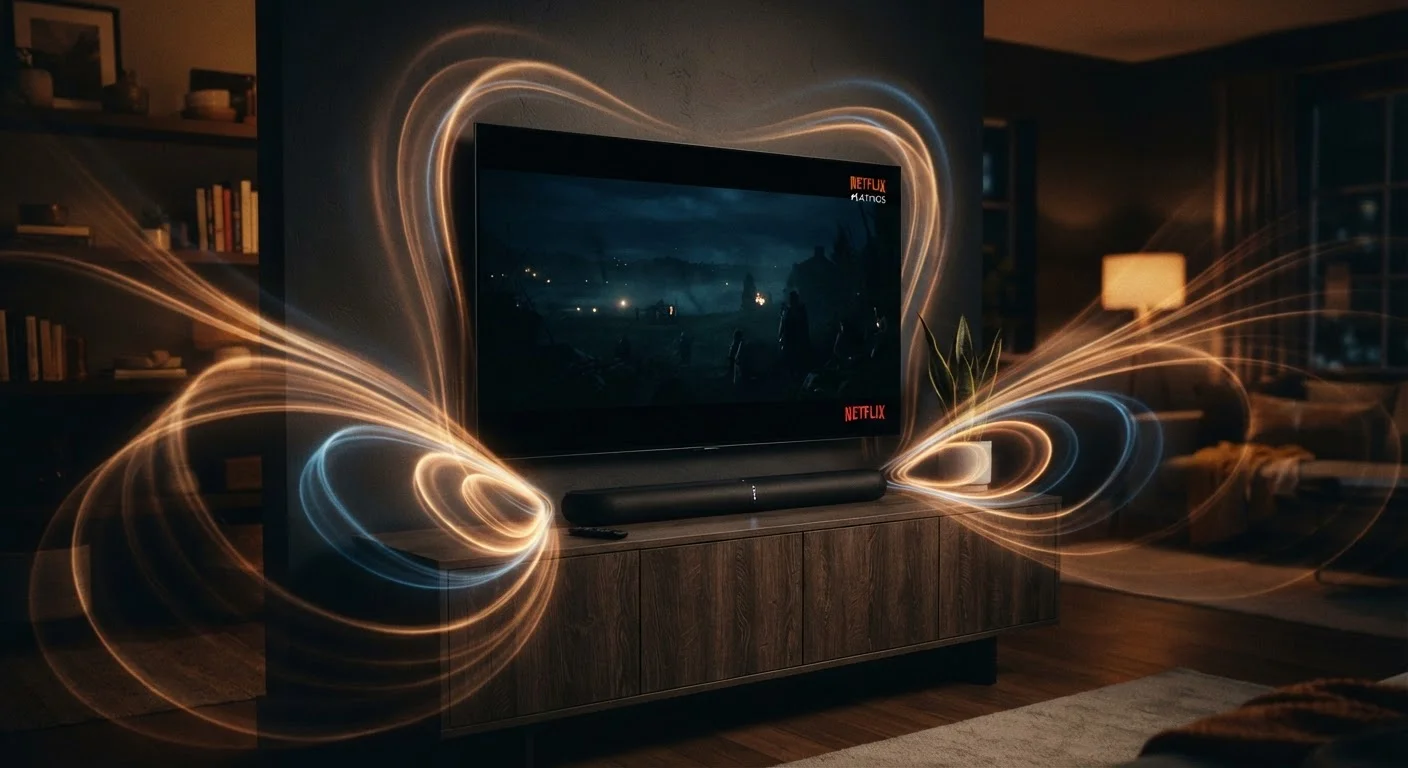
Dolby Atmos, introduced in commercial cinemas in 2012 and brought to home systems thereafter, takes a fundamentally different approach called object-based audio. Instead of assigning sounds to channels, a mixer places audio as individual objects in a three-dimensional space, each with X, Y, and Z coordinates. The Atmos renderer in your receiver then calculates which physical speakers to use — and at what volume — to position that object accurately in real time.
This matters because the renderer adapts to your actual speaker layout. Whether you have a 5.1.2 system (the final digit indicating two height speakers) or a 7.1.4 system, Atmos recalculates object placement accordingly. The overhead dimension is what makes Atmos perceptually distinctive: rain falls from above, a helicopter circles overhead, ambient room noise wraps around and over the listener rather than just around them.
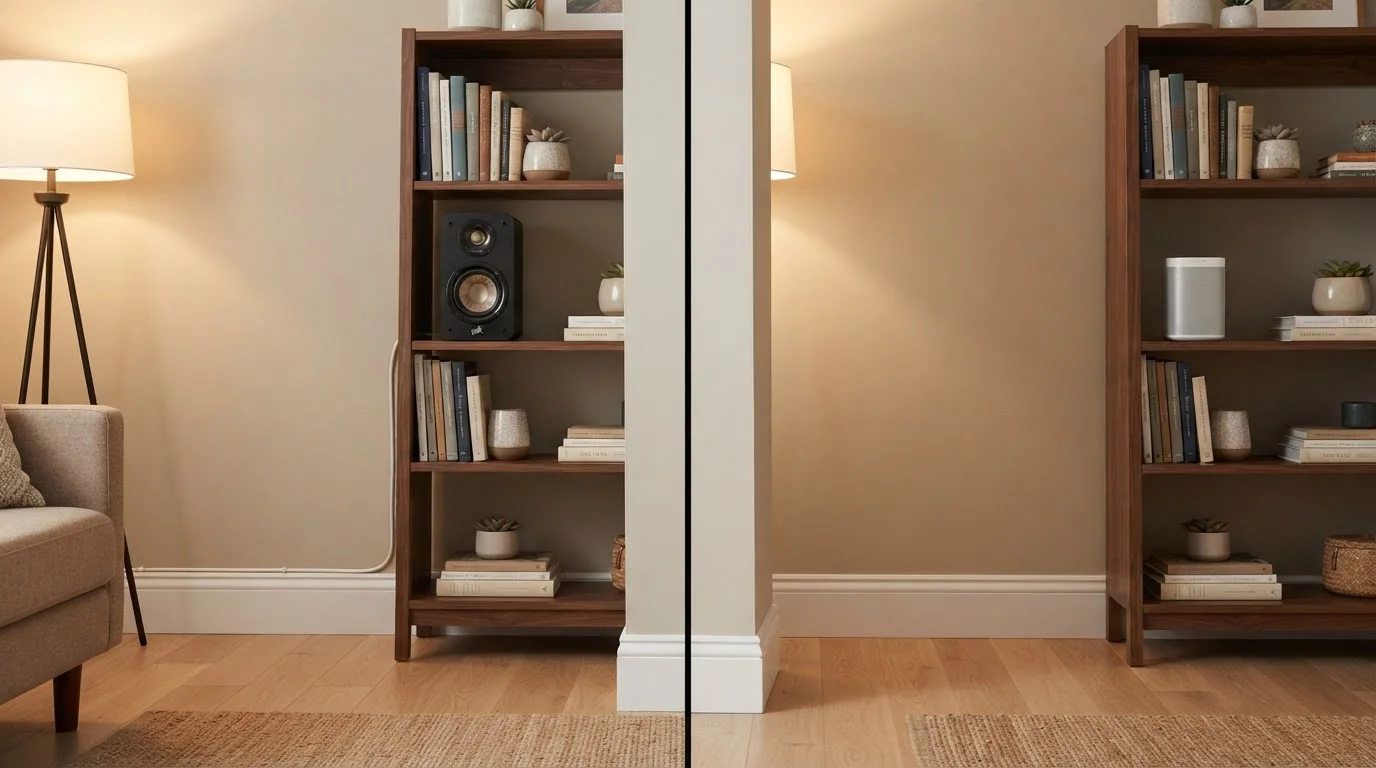
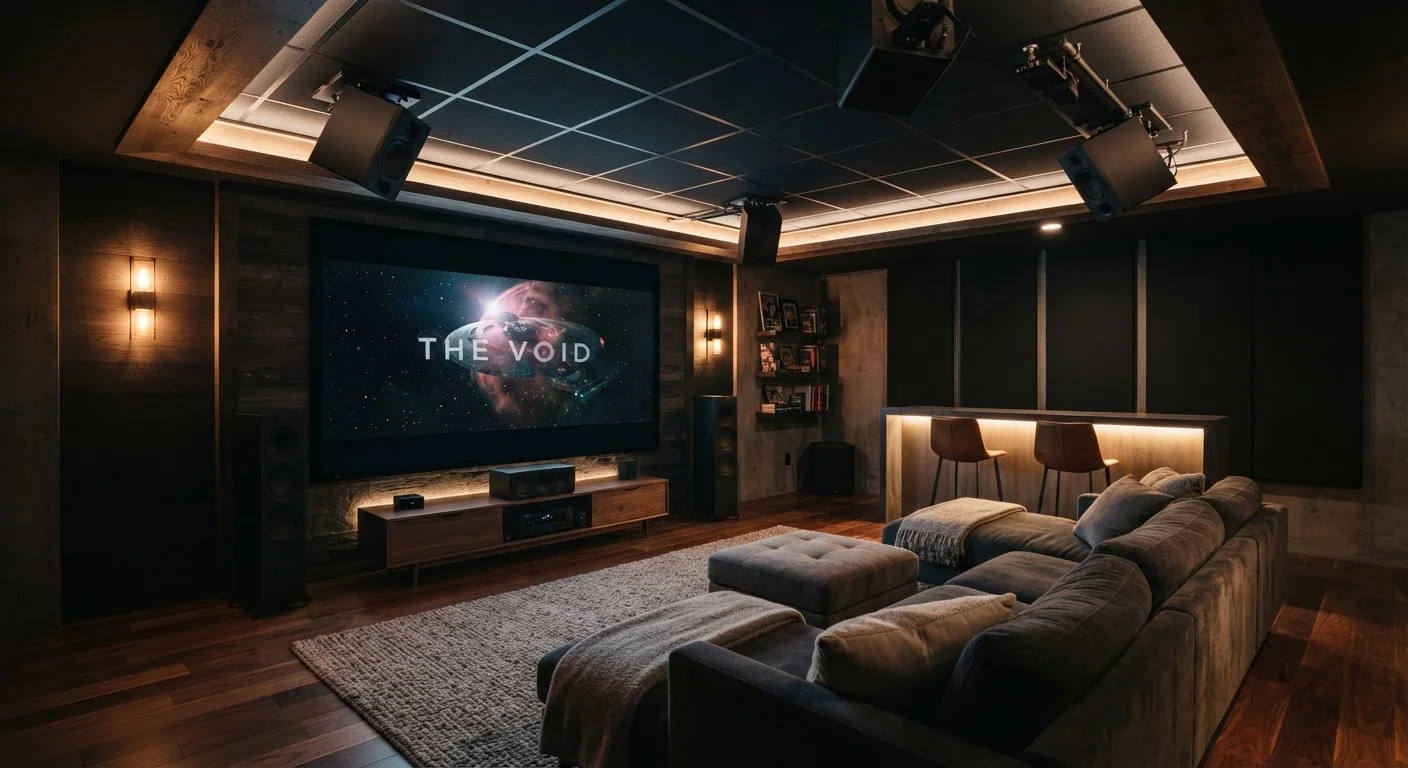
To reproduce height, you have two practical options: ceiling-mounted speakers aimed directly downward, or upward-firing drivers built into or placed on top of floor-standing or bookshelf speakers. Upward-firing designs reflect sound off the ceiling to simulate height — an approximation that works better in rooms with flat, reflective ceilings at a normal height. For a deeper look at how soundbars attempt this same trick with even fewer drivers, see how a soundbar fakes surround sound.
| Criterion | Traditional Surround Sound | Dolby Atmos |
|---|---|---|
| Audio approach | Channel-based (fixed assignments) | Object-based (3D positioning) |
| Height dimension | None natively | Yes — overhead speakers required |
| Common configurations | 5.1, 7.1 | 5.1.2, 7.1.4 (height channels added) |
| Hardware complexity | Lower — standard speaker placement | Higher — ceiling or upward-firing speakers |
| Content availability | Universal across all formats | Wide — streaming and 4K Blu-ray |
| Receiver requirement | Any AV receiver | Atmos-capable AV receiver or soundbar |
| Room sensitivity | Moderate | Higher — ceiling type affects height effect |
Content Availability and Compatibility
One practical consideration is what content you can actually play. Dolby Atmos tracks are now widely available: major streaming platforms carry Atmos audio on select titles, and many 4K Blu-ray discs include Atmos as the primary audio track alongside a standard surround mix. Your AV receiver or soundbar must be Atmos-compatible to decode these tracks; otherwise it typically falls back to a standard surround mix automatically, so you won't lose audio — just the height layer.
Traditional surround sound content is, if anything, even more ubiquitous. Every Blu-ray, most DVDs, broadcast television, and virtually all streaming tiers carry at minimum a 5.1 mix. There's no compatibility gap to worry about. If your receiver and speakers support 5.1 or 7.1, the content ecosystem fully supports you.
It's also worth noting that Atmos is not the only object-based format. DTS:X is a competing standard with similar principles. Most current AV receivers that support Atmos also support DTS:X, so choosing Atmos-capable hardware generally covers both bases. Just as with video, where formats like Dolby Vision and HDR10 compete for screen real estate — see HDR formats explained — audio formats coexist rather than displace each other entirely.
Installation Realities and Room Considerations
The gap between the two systems becomes most visible during setup. A traditional 5.1 system requires five speakers and a subwoofer positioned at ear level — demanding, but a well-understood process covered by decades of placement guidelines. Wiring runs along walls or under floors. For a broader look at the trade-offs between wired and wireless audio approaches, wired vs. wireless home audio covers the key considerations.
Adding Atmos height channels means either running speaker wire to the ceiling (often requiring an electrician or at minimum some construction work) or accepting the performance compromises of upward-firing drivers. Room geometry matters significantly: low ceilings, angled ceilings, or heavily absorptive materials overhead will diminish the height effect. Open-plan living spaces present their own acoustic complications — open floor plans affect acoustics in ways that can reduce surround and Atmos effectiveness alike.
The honest assessment is that a well-calibrated traditional surround system in a treated room will frequently outperform a poorly positioned Atmos system. The technology ceiling matters less than execution. If your room, budget, and installation options support proper height speaker placement, Atmos delivers a perceptibly different experience. If they don't, the existing surround standard remains a capable and fully supported format.
5.1
Most common home surround configuration
Five-channel surround with a dedicated subwoofer has been the standard home theater baseline since the DVD era.
3D
Axis dimensions in Dolby Atmos
Atmos places audio objects across horizontal, lateral, and vertical axes, compared to the two-dimensional plane of traditional surround.
128
Maximum simultaneous audio objects in Atmos
The Dolby Atmos specification supports up to 128 simultaneous audio objects in a cinema mix, with home implementations using a subset of that capacity.