What HDR Actually Does
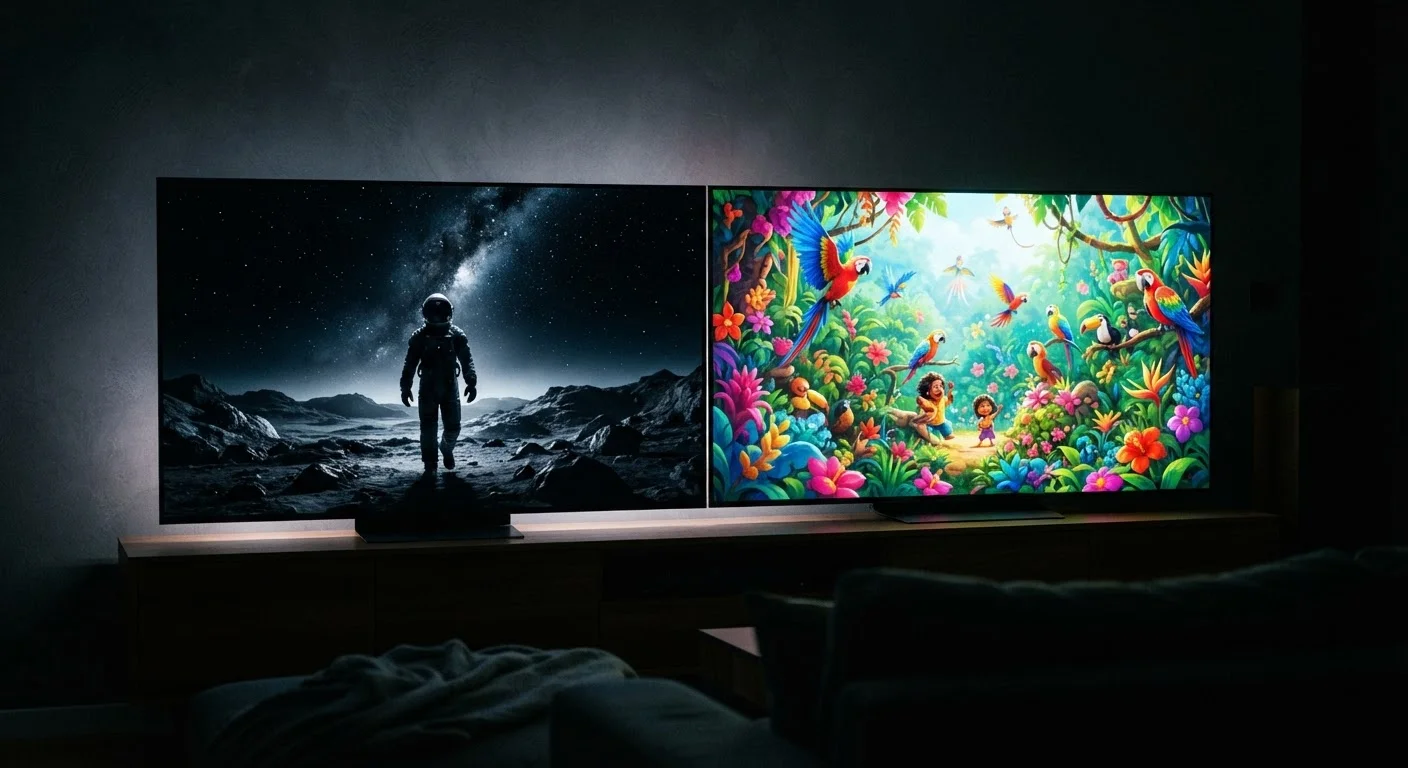
HDR stands for High Dynamic Range — a set of technologies that expand the gap between the brightest highlights and the darkest shadows a screen can display simultaneously. In practical terms, HDR makes a candle flame look genuinely bright against a dark room, instead of just slightly brighter than average. It also enables a wider range of colors, particularly in the orange-red and blue-green spectrum where standard video often falls flat.
But HDR isn't a single standard — it's a family of competing formats, each with different rules for how brightness data is encoded, delivered, and displayed. Understanding the differences helps explain why the same content can look noticeably different on two HDR-capable screens. As we note in our companion piece, resolution is only one piece of picture quality — HDR format support is another critical variable.
| HDR10 color bit depth | 10-bit (Consumer Electronics Association HDR specification) |
| Dolby Vision mastering ceiling | Up to 10,000 nits (Dolby Laboratories technical documentation) |
| HDR10 metadata type | Static (set per title) (SMPTE ST 2086 standard) |
| HLG developed by | BBC and NHK (ITU-R BT.2100 broadcast standard) |
| Dolby Vision licensing model | Closed / requires licensing (Dolby Laboratories) |
| HDR10+ licensing model | Open / royalty-free (HDR10+ Technologies LLC) |
| HLG metadata requirement | None — uses a mathematical curve (ITU-R BT.2100) |
| HDR10 minimum peak brightness target | 1,000 nits (Consumer Electronics Association) |
HDR10, Dolby Vision, and HLG: A Format-by-Format Breakdown
HDR10 is the baseline open standard, supported by virtually every HDR-capable TV, streaming service, and Blu-ray disc released in the past decade. It uses static metadata — brightness and color instructions set once for an entire film or episode — and targets a peak brightness of 1,000 nits. Because it's royalty-free and widely adopted, content producers and device makers face no licensing barrier. The tradeoff is that one-size-fits-all brightness mapping can clip highlights or crush shadows in scenes that deviate dramatically from the overall average.
HDR10+ is an open extension of HDR10 developed by Samsung and Amazon. It adds dynamic metadata, meaning brightness instructions are recalculated scene by scene or even frame by frame. This produces more accurate tone mapping without requiring the full Dolby Vision ecosystem.
Dolby Vision is a licensed, closed standard that also uses dynamic metadata, but specifies a more comprehensive pipeline from production studio to your living room. Dolby Vision content is mastered at up to 10,000 nits and uses 12-bit color depth (versus HDR10's 10-bit), though most current displays can't render those absolute peaks. What matters is that the format carries far more data for a TV to work with, giving capable displays more room for precise tone mapping. Licensing costs mean not every device or streaming service supports it — compatibility with your display panel technology matters here.
HLG (Hybrid Log-Gamma) takes a fundamentally different approach. Developed by the BBC and NHK for broadcast television, HLG encodes HDR information in a way that is backward-compatible with standard-dynamic-range (SDR) displays — an SDR TV will still show a watchable image from an HLG signal. It uses no metadata at all; instead, the display interprets brightness using a built-in mathematical curve. HLG is the dominant format for live broadcast HDR, including sports and news, where pre-mastering every frame is impractical.
Dynamic metadata
Instructions embedded in a video signal that tell a display how to adjust brightness and color on a scene-by-scene or frame-by-frame basis. Formats like Dolby Vision and HDR10+ use dynamic metadata for more precise tone mapping.
Static metadata
A single set of brightness and color instructions applied uniformly to an entire piece of content. HDR10 uses static metadata, which is simpler but less adaptable to scenes that vary widely in brightness.
Tone mapping
The process a display uses to fit the brightness range of a source signal into what the screen can actually reproduce. Better tone mapping preserves highlight and shadow detail when a TV's peak brightness is lower than the mastering target.
Nit
A unit of luminance (brightness) equal to one candela per square meter. Consumer HDR displays commonly range from around 400 to over 2,000 nits at peak, while HDR mastering standards reference up to 10,000 nits.
HLG (Hybrid Log-Gamma)
An HDR format designed for live broadcast that requires no metadata. It uses a mathematical curve that allows the same signal to display acceptably on both HDR and standard-dynamic-range televisions.
Color bit depth
The number of distinct values available to represent each color channel. Higher bit depth (e.g., 12-bit vs. 10-bit) allows smoother gradients and reduces banding — visible stepping between shades in areas like sky or shadow.
Compatibility and Real-World Implications
When you're choosing or using a display, a few practical points follow from the format differences above.
- HDR10 is the floor, not the ceiling. Every Dolby Vision and HDR10+ source also includes an HDR10 fallback layer, so a TV that only supports HDR10 will still display HDR content — just without the more precise dynamic mapping.
- Dolby Vision requires end-to-end support. The content, the streaming app, and the display all need to support Dolby Vision for the full format to activate. A Dolby Vision disc played through a non-Dolby-Vision-certified player will fall back to HDR10.
- HLG matters most for broadcast and live content. If you watch live sports or news in HDR, your TV's HLG support determines whether you see a proper HDR image or a flat SDR one.
- Peak brightness is a ceiling, not a guarantee. A TV rated for 600 nits will tone-map both HDR10 and Dolby Vision content to fit within that range — the format determines how intelligently that mapping is done, not whether it happens.
The connection between your HDMI version and HDR delivery is also worth understanding — see our explainer on what HDMI 2.1 actually does for your TV picture for how bandwidth affects the signal chain. For projector owners, HDR behavior differs meaningfully from flat-panel TVs — the viewing experience comparison between projectors and large-screen TVs covers how each handles light and contrast.