Why Puzzle Type Matters
Not every puzzle is created equal, and that's exactly what makes the hobby so rich. Someone who loves wordplay may find a Sudoku frustrating, while a number enthusiast might abandon a crossword after two clues. Understanding the landscape of puzzle types helps you invest your leisure time in something that genuinely clicks — and keeps you coming back.
Puzzles are also more than entertainment. Research in cognitive science consistently links regular puzzle engagement to improvements in working memory, attention, and flexible thinking. But those benefits are most accessible when you're engaged, not grinding through a format you dislike. Think of puzzle categories like genres in fiction: once you know what you enjoy, you can explore endlessly within it — or branch out deliberately when you want a challenge.
This guide maps the major puzzle families, what each one demands from your brain, and how to figure out where you belong. Whether you're a solo solver or looking for group activities, there's a format that fits.
Word Puzzles: Crosswords, Word Searches, and Anagrams
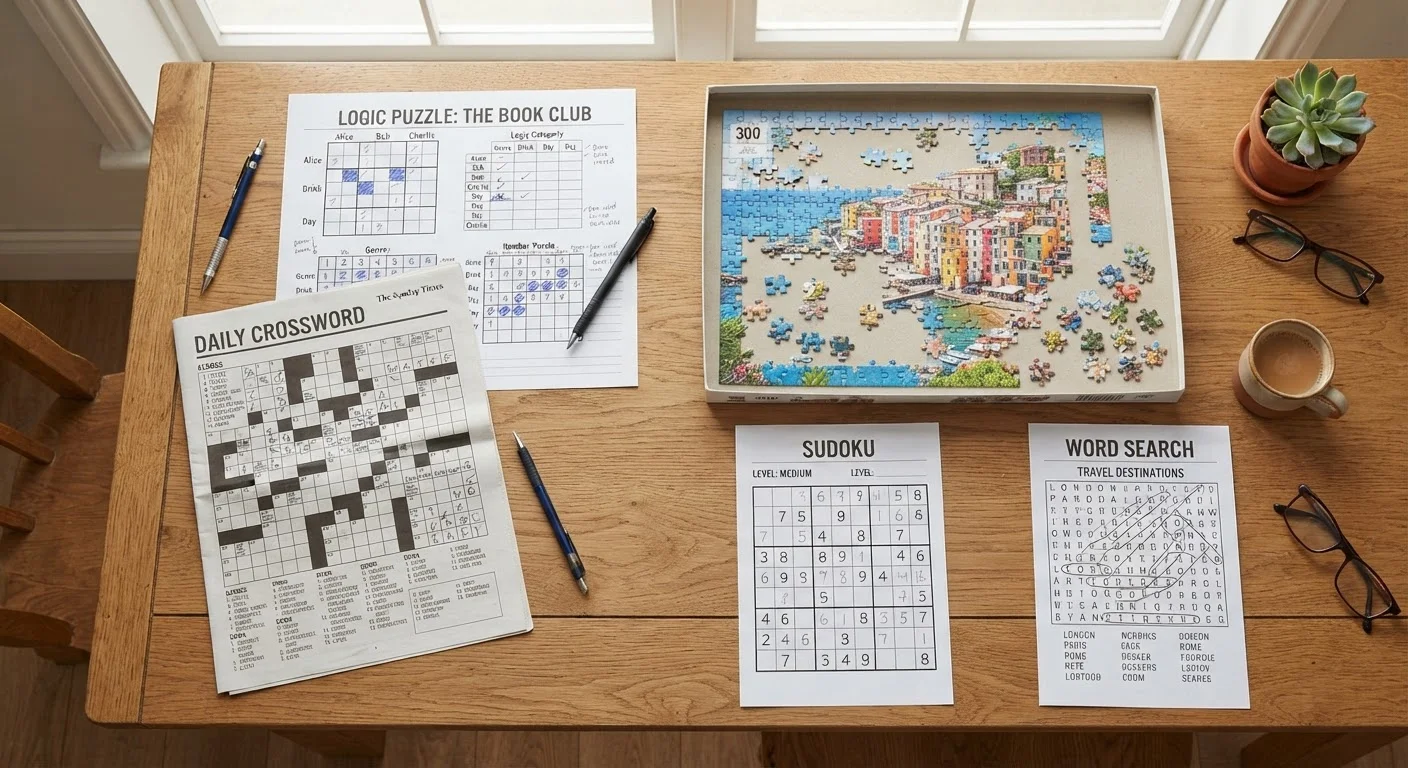
Word puzzles are probably the category most people encounter first. Crosswords are the gold standard — they combine vocabulary, trivia, and lateral thinking in a satisfying interlocking grid. American-style crosswords (popularized by publications like the New York Times) follow strict symmetry rules and range from breezy Monday grids to famously tricky Saturdays. British cryptic crosswords operate by entirely different rules, using wordplay clues that require decoding rather than straight definitions.
Word searches are more accessible and less competitive — great for winding down or introducing younger solvers. Anagram puzzles scramble letters and ask you to reconstruct a word or phrase, exercising rapid mental restructuring.
When starting crosswords, work the Monday grids of a single publication exclusively for a month. You'll internalize that editor's conventions and vocabulary faster than sampling random puzzles from multiple sources.
Each crossword editor has consistent stylistic patterns. Building familiarity with one set of conventions accelerates skill development and reduces beginner frustration.
For logic grids, always mark confirmed eliminations first before attempting positive placements — it prevents cascading errors that can derail an otherwise solid solve.
Logic grid errors most often stem from premature positive assignments. Elimination-first is the methodological approach used by competitive solvers to maintain grid integrity.
All word puzzles reward a broad, active vocabulary, but they also reward familiarity with common puzzle conventions — abbreviations, repeated fill words, and crossword-specific shorthand. Beginners benefit enormously from starting with easier grids and reading the annotations that many puzzle sites provide after you solve.
Number and Math Puzzles: Sudoku and Beyond
Sudoku is the gateway drug of number puzzles — it requires no math beyond recognizing the digits 1 through 9, yet demands rigorous logical elimination. Its appeal crosses age groups and languages precisely because it's language-free. Difficulty scales cleanly from beginner (many given digits) to expert (requiring advanced techniques like X-wings or swordfish patterns).
Beyond Sudoku, Kakuro blends crossword structure with arithmetic: each run of cells must sum to a given number using non-repeating digits. Nonograms (also called Picross) use numerical clues to fill a grid, revealing a pixel-art image when solved. KenKen introduces basic arithmetic operations into a Latin-square format, making it a favorite in math-forward classrooms.
Number puzzles are particularly satisfying for solvers who appreciate definitive, provable solutions. Unlike trivia-heavy word puzzles, there's no knowledge base required — just patience and logical discipline.
Logic Grids and Deductive Puzzles
Logic grid puzzles present a set of clues and ask you to determine relationships among a group of people, places, or objects. A classic example: five neighbors each own a different pet, drive a different car, and drink a different beverage — your job is to assign each attribute correctly using only the clues given. Solvers work through a matrix, eliminating impossible combinations until one arrangement remains.
These puzzles are methodical by design. They reward those who enjoy systematic elimination over intuitive leaps, and they have a satisfying completeness — when you're done, the answer is unambiguously correct. Logic grids are also excellent training for structured thinking in everyday life, from planning a schedule to troubleshooting a problem.
A related format, constraint puzzles, appears in many digital games and competitive math contexts, requiring solvers to satisfy a set of rules simultaneously. If you enjoy logic grids, exploring puzzle books dedicated to them or apps like Logic Puzzles can provide hundreds of variations at escalating difficulty.
Visual and Spatial Puzzles: Jigsaws, Mazes, and More
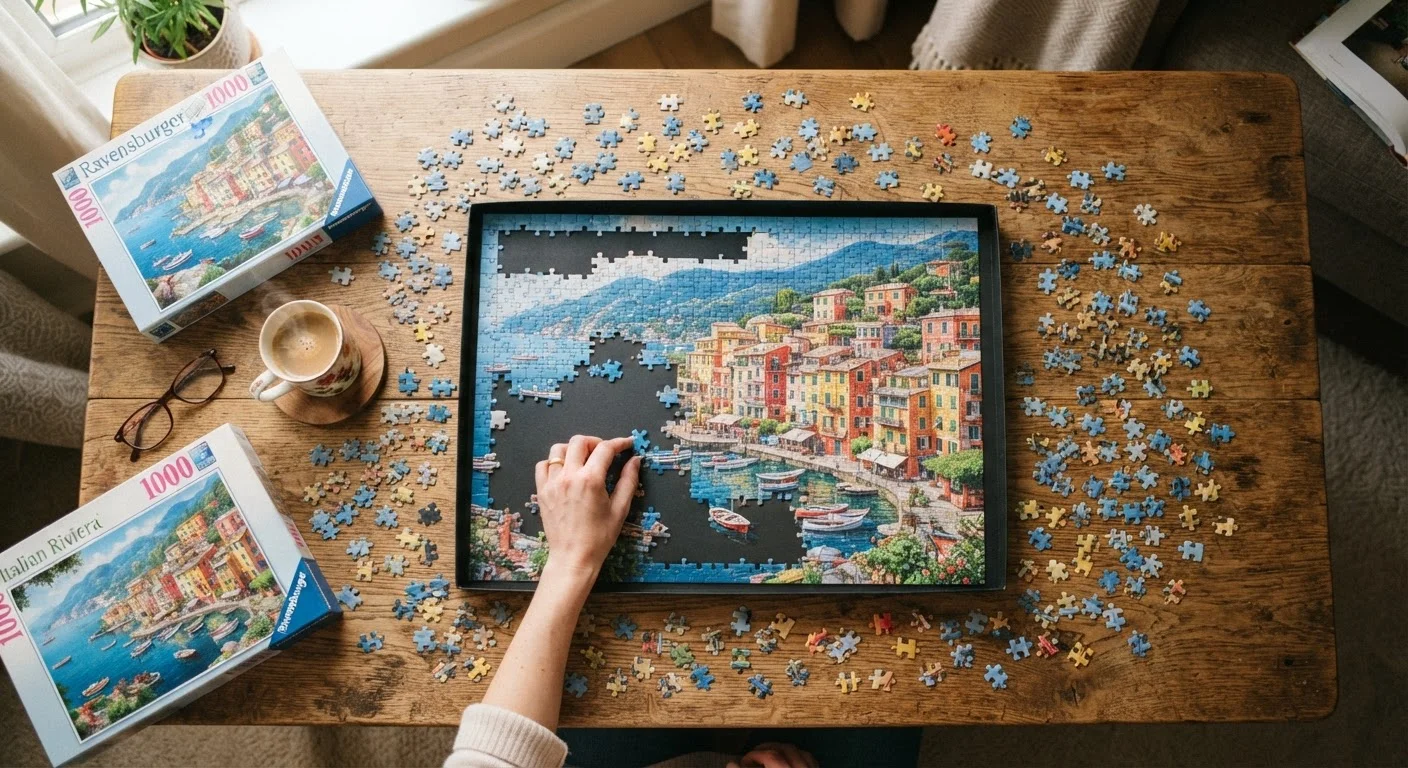
Visual puzzles engage the brain's spatial reasoning centers more directly than language- or number-based formats. Jigsaw puzzles are the most beloved example — they require pattern matching, edge recognition, and color sorting to reconstruct an image. Difficulty isn't determined by piece count alone; image complexity, cut style, and piece uniformity all play a role. Our guide on what piece count, image type, and cut style actually mean breaks this down thoroughly.
Mazes are among the oldest puzzle forms, and they remain satisfying because they mimic real navigational decision-making. Tangrams and pentomino puzzles ask solvers to assemble geometric shapes into a target outline, demanding strong mental rotation skills. Optical illusion puzzles challenge perception itself, asking you to find hidden images or count objects that shift with viewing angle.
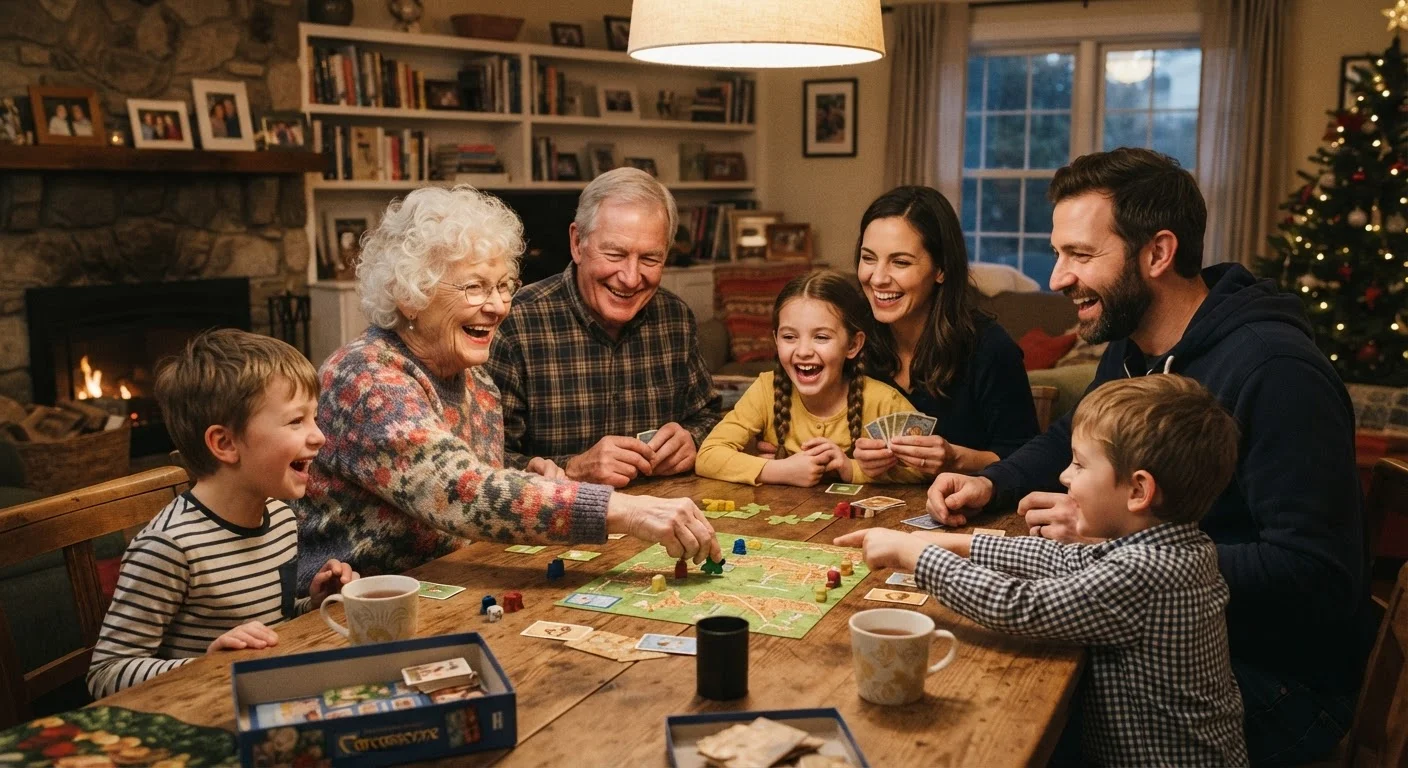
Visual puzzles tend to be especially accessible across age groups and are often well-suited to mixed-age gatherings. If you're hosting a group, see our tips on keeping mixed-age groups engaged for pairing puzzle types with participants.
Collaborative and Hybrid Puzzle Formats
Not all puzzles are solitary pursuits. A growing category blends puzzle mechanics with narrative or group cooperation, making the solving experience inherently social.
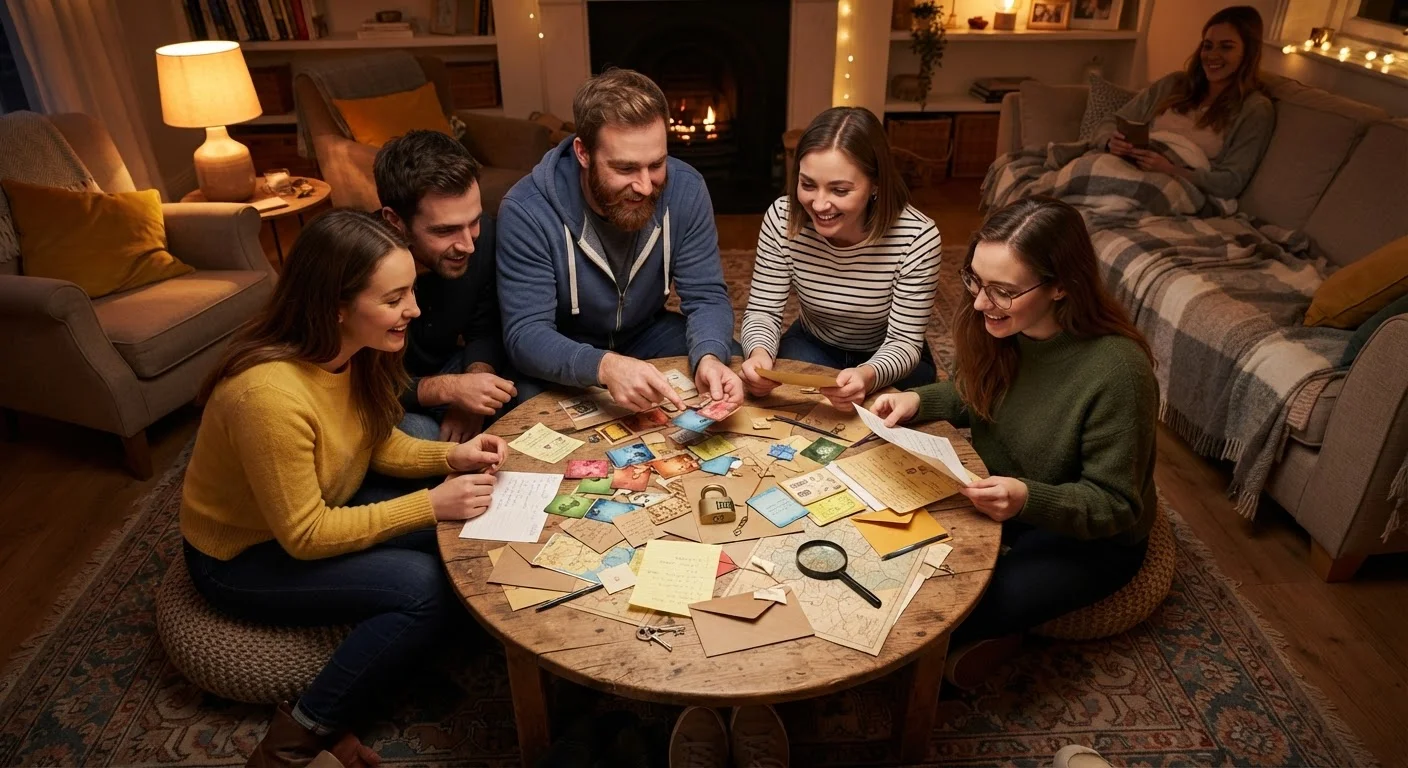
Escape room games — both commercial venues and at-home boxed versions — require teams to solve interconnected puzzles under time pressure, often with a storyline driving the urgency. They blend logic, word, visual, and spatial puzzles into a layered experience that rewards communication and diverse thinking styles. If the format interests you, our overview of escape room games at home explains the formats available and what to expect.
Puzzle hunts are another collaborative format, popular on college campuses and at organized events, where teams solve interconnected clues across a physical or digital space. Cooperative jigsaw puzzles and mystery puzzle boxes — which include a narrative to decode alongside the image — sit at the intersection of storytelling and spatial challenge.
These hybrid formats are worth exploring if you find solo puzzles isolating or if you want an activity that naturally encourages conversation. They also pair well with the broader world of strategy and thematic games; understanding the difference between pure logic and narrative-driven play, as explored in our piece on abstract strategy vs. thematic games, can help you choose the right experience for your group.
How to Find Your Puzzle Fit
The simplest way to find your fit is to try one puzzle from each major category — ideally at a beginner level — before investing in books, subscriptions, or games. Most puzzle formats are available free online, which makes low-stakes sampling easy.
Ask yourself a few diagnostic questions: Do you enjoy trivia and language, or do you prefer pure logic? Do you work best alone and quietly, or does a social, time-pressured challenge appeal? Are you motivated by visual beauty (jigsaw images, nonogram pixel art) or by the elegance of a solved equation?
Your answers will point you toward a category. From there, difficulty progression is your friend — start accessible, build confidence, then graduate to harder variants. Most puzzle communities, whether online forums or local puzzle clubs, are welcoming to beginners and happy to recommend what to try next.
Puzzles are also a wonderful entry point into broader creative and analytical hobbies. If you're mapping out what leisure activities suit you as an adult, our guide to creative hobbies for adults offers a wider view of what's realistically accessible to start.